An Automated Warehouse Racking System is more than steel uprights and beams. It shapes how goods move, how quickly orders are picked, and how safely space is used. In a busy distribution center, a few centimeters of aisle width can affect forklift movement, storage capacity, and daily throughput. The right system depends on the operation: pallet flow, drive-in, push-back, and automated storage each solve different problems.
The investment case is growing. MHI and Deloitte’s 2024 Annual Industry Report found that 55% of surveyed supply chain professionals planned to increase spending on supply chain technology and innovation. That figure does not guarantee a return for every warehouse. Product mix, building height, fire protection, maintenance access, and future expansion all matter. A glossy capacity estimate can miss the everyday bottleneck: a replenishment task that blocks a picking aisle.
As warehouse expert James A. Tompkins put it, “The warehouse is the heart of the supply chain.” His observation is a useful lens for comparing manufacturers, though it is not a substitute for site-specific engineering. This guide to the Top 10 Automated Warehouse Racking System Manufacturers examines solutions, capabilities, and practical selection factors. It also leaves room for uncertainty: published specifications rarely reveal how a system performs under a facility’s exact operating conditions. Shortlist carefully. Then verify the details.
Automated Warehouse Racking Systems: Definition and Core Components
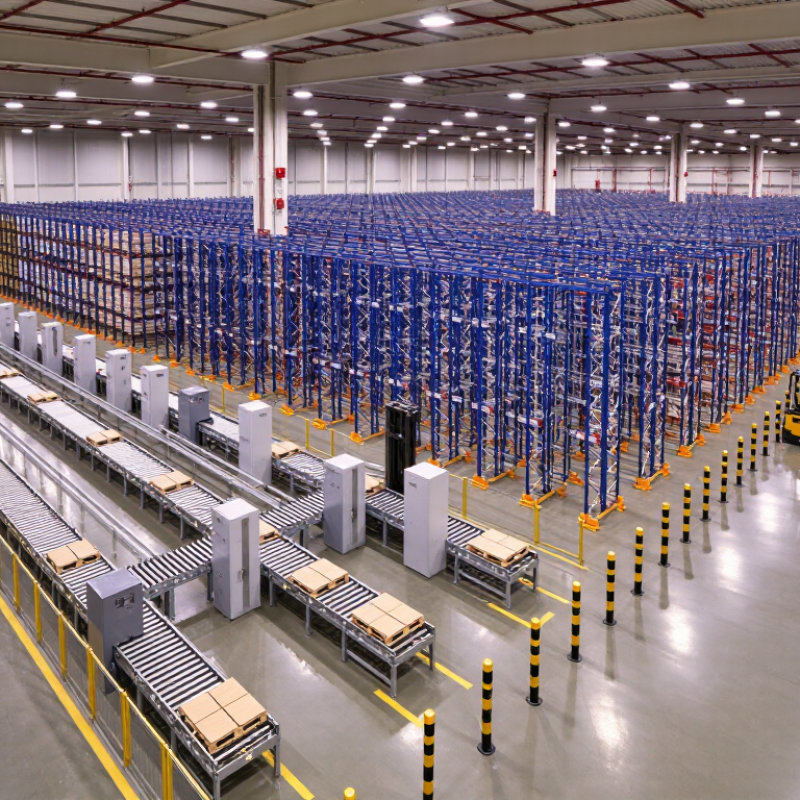
An automated warehouse racking system stores and retrieves goods with limited manual handling. It combines high-density racks with machines and software that direct inventory movement. Unlike static shelving, it can bring a pallet or tote to a specific pickup point. That distinction matters.
The rack structure supports stored loads and guides moving equipment through narrow aisles. Automated cranes travel vertically and horizontally, while shuttle devices move loads along rack channels. Conveyors and lifts connect storage areas with packing or receiving stations. Sensors track load positions and detect obstructions. Small details matter.
Control software coordinates equipment and inventory records. A warehouse management system typically assigns storage locations, while a warehouse control system sends commands to cranes, shuttles, and conveyors. Safety features may include guarded access points, emergency stops, and presence sensors. Performance depends on accurate load dimensions and reliable data. A poorly sized pallet can disrupt a smooth sequence. The layout is not always as elegant as a drawing suggests; service access and maintenance space can reduce storage capacity. Those trade-offs deserve attention during planning.
Top 10 Automated Warehouse Racking System Manufacturers - Automated Warehouse Racking Systems: Definition and Core Components
This manufacturer-neutral overview compares ten established automated storage and retrieval system types rather than ranking companies. Automated warehouse racking systems combine storage structures with mechanized or robotic equipment and control software to store and retrieve inventory.
| No. | System Type | How It Works | Core Components | Typical Applications | Key Considerations |
|---|---|---|---|---|---|
| 1 | Unit-Load AS/RS | Storage and retrieval machines move palletized loads through high-bay rack aisles. | Unit-load racks, aisle crane or storage-and-retrieval machine, load handling device, conveyors, warehouse control system (WCS), warehouse management system (WMS). | High-volume pallet storage in distribution centers and manufacturing facilities. | Requires coordinated rack, machine, load, and building design; aisle equipment generally serves defined storage aisles. |
| 2 | Mini-Load AS/RS | A crane or shuttle retrieves totes, trays, or cartons from compact storage locations. | Small-load rack, mini-load crane or shuttle, totes or trays, input/output stations, conveyors, WCS and WMS. | Small-parts storage, order picking, and buffer storage. | Load dimensions and weight must fit the selected carrier and storage location. |
| 3 | Shuttle-Based AS/RS | Shuttles travel along rack levels to move pallets, totes, or trays to lifts and transfer points. | Multi-level rack, rail-guided shuttles, lifts, transfer conveyors, charging arrangements, WCS and WMS. | High-throughput storage where multiple storage levels and frequent access are required. | System throughput depends on the combined performance of shuttles, lifts, and transfer equipment. |
| 4 | Pallet Shuttle Rack System | A powered shuttle carries pallets along rails inside deep-lane rack channels, reducing forklift travel into the lanes. | Drive-in or lane rack, shuttle rails, pallet shuttle, forklift or transfer interface, controls and safety devices. | High-density storage of multiple pallets of the same product or products managed by lane. | Deep-lane access is less selective than single-deep storage; lane and inventory rules are important. |
| 5 | Automated Pallet Crane System | An aisle-bound crane places and retrieves pallet loads from rack locations, often using conveyors at aisle ends. | Pallet racking, stacker crane, forks or load-handling device, conveyor interface, scanners, WCS and WMS. | Automated pallet handling for warehouses with repeatable load units and structured flows. | Load stability, pallet quality, aisle layout, and transfer-point design affect reliable operation. |
| 6 | Vertical Lift Module (VLM) | An enclosed unit stores trays vertically and presents selected trays at an access opening. | Enclosed frame, vertical lift mechanism, trays, access opening, control interface, and inventory software connection. | Small parts, tools, and components where floor space is limited and controlled access is useful. | Tray dimensions, load limits, and item placement determine how effectively the unit can be used. |
| 7 | Vertical Carousel | Bins or shelves circulate vertically on a continuous loop and deliver the requested storage position to an operator. | Rotating carriers, drive system, frame, access opening, safety controls, and retrieval interface. | Small-item storage and picking in production, maintenance, and parts areas. | Items are accessed at a presentation opening; load dimensions and carousel capacity constrain storage choices. |
| 8 | Horizontal Carousel | Rotating carriers circulate horizontally to present storage bins to a picking station. | Horizontal carriers, track or support frame, drive system, picking station, controls, and inventory software. | Batch picking of small items in operations with a suitable horizontal installation footprint. | Performance depends on coordinated carrier movement, picking procedures, and order grouping. |
| 9 | Cube-Based Robotic Storage | Robots move across the top of a dense bin grid, access bins, and deliver them to workstations. | Structural grid, bins, mobile robots, workstations, charging infrastructure, fleet control, and WMS integration. | High-density tote or bin storage with goods-to-person picking. | Grid design, bin compatibility, workstation capacity, and robot fleet management influence throughput. |
| 10 | Mobile-Robot Goods-to-Person Storage | Autonomous mobile robots transport shelves, racks, or containers between storage areas and operator stations. | Mobile robots, storage units or load carriers, navigation and traffic control, workstations, charging points, and WMS or WCS. | Flexible order picking for facilities that need adaptable storage and workstation layouts. | Requires managed pedestrian and robot traffic, suitable floor conditions, and clear operating procedures. |
FAQS
It stores goods in dense racks and moves pallets or totes to pickup points. Machines handle much of the movement.
Cranes travel vertically and horizontally. Shuttles move loads along rack channels, while conveyors and lifts connect storage with packing or receiving areas. Sensors detect positions and obstructions.
Consider load sizes, order patterns, ceiling height, and future product changes. Selective racks offer direct pallet access; dense systems may suit similar, high-volume goods. The best fit depends on daily work.
It saves aisle space and suits stable inventory. But inner pallets may be harder to reach, so replenishment and picking paths need careful planning. Not always obvious.
Software assigns locations and directs equipment using inventory records. An oversized or uneven pallet can interrupt movement, while inaccurate data may send equipment to the wrong location. Small details matter.
Guarded access points, emergency stops, and presence sensors can help protect people near moving equipment. Ask how sensors respond to blocked aisles and other interruptions.
Share actual pallet sizes, peak shifts, aisle widths, and order mix. Request calculations for beam capacity, floor loading, clearances, and seismic conditions. Check whether maintenance access reduces storage space.
Review software connections, failure testing, commissioning records, operator training, spare parts, and realistic response times. Speak with a comparable site’s maintenance team if possible. Look closely.
Include energy, inspections, upgrades, service, and planned downtime over a stated period. Extra automation may not pay off in a low-volume operation. Forecasts still miss awkward exceptions.
Conclusion
An Automated Warehouse Racking System combines storage structures with technologies such as conveyors, shuttles, lifts, sensors, and warehouse control software to move and manage goods with less manual handling. Common system types include pallet shuttle systems, automated storage and retrieval systems, vertical lift modules, and high-density automated solutions. Each serves different needs depending on warehouse space, inventory characteristics, throughput targets, and order profiles.
Choosing a manufacturer requires evaluating system performance, safety features, integration options, customization, service support, and long-term operating costs. The top manufacturers can be compared by their technical capabilities, project experience, scalability, and suitability for specific applications. The best fit is not necessarily the most complex system, but the solution that aligns with a warehouse’s operational goals, available space, budget, and future growth plans.