FILO Push Back Pallet Rack System: Architecture, ROI, and Technical Buying Insights
An expert operational analysis of First-In, Last-Out (FILO) nested cart push back storage technology for supply chain leaders, warehouse managers, and global procurement specialists.
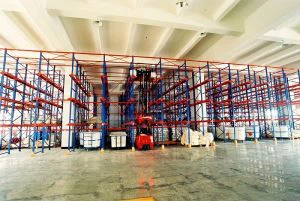
In modern industrial logistics, static storage methods like conventional selective racking often fail to satisfy the dual requirements of high floor space utilization and fast pallet picking speeds. As real estate development costs and warehouse square-meter rental rates rise globally, supply chain directors are turning to high-density dynamic storage. The FILO Push Back Pallet Rack System stands out as one of the most efficient, durable, and high-yield solutions designed for dense pallet storage without driving into racking aisles.
At Random Racks Storage Equipment Co., Ltd., founded in 2004, we have designed, manufactured, and deployed thousands of high-density pallet rack structural projects across Europe, North America, Australia, and the Middle East. This detailed engineering manual explains the mechanics, operational advantages, structural criteria, economic ROI, and emerging technology trends of the FILO push back pallet rack system.
Information Gain: How FILO Push Back Racking Solves the "Drive-In Bottleneck"
Unlike Drive-In racking—which forces forklift drivers to slowly navigate inside narrow structural corridors—a FILO Push Back Pallet Rack System keeps forklift trucks strictly in the main aisle. Pallets are loaded onto telescoping nested carts that glide along inclined structural steel rails. Every aisle picking face remains accessible, reducing average loading and unloading cycle times by up to 55% while virtually eliminating lift truck impact damage to upright frames.
1. System Architecture & How FILO Push Back Racking Operates
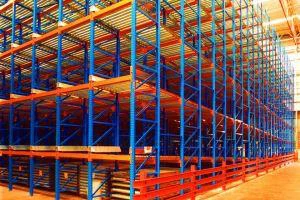
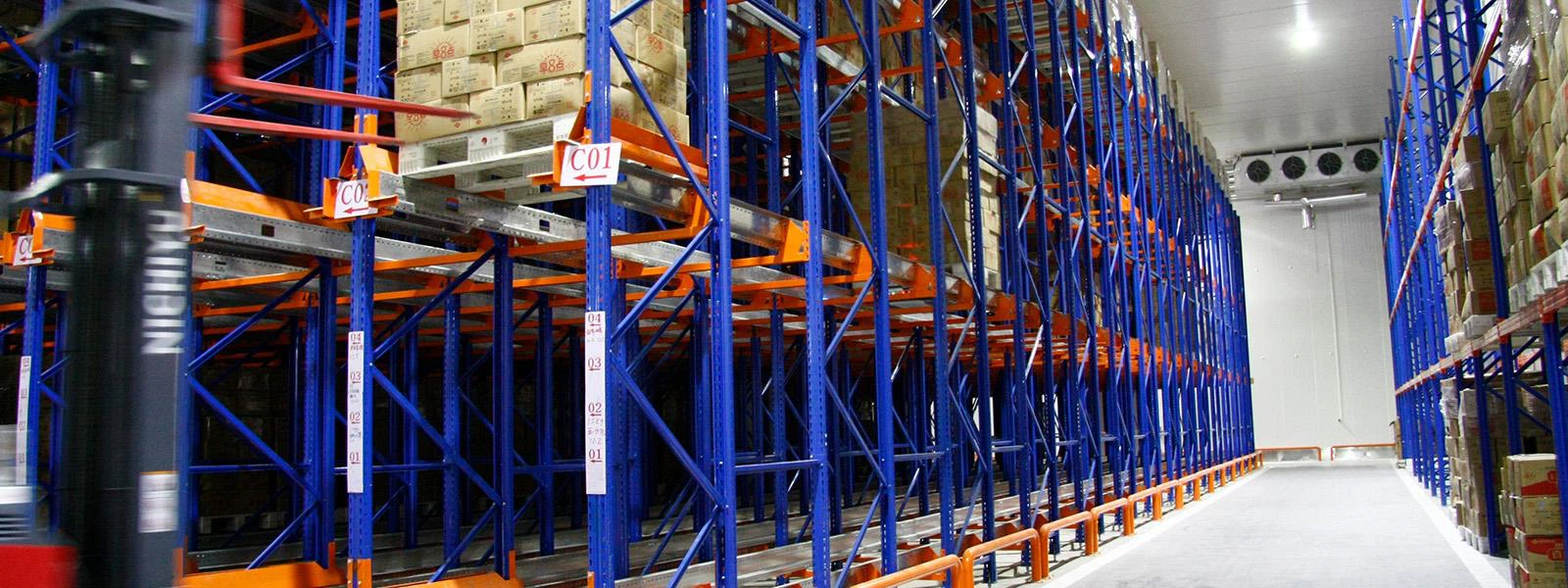
The core operating principle of a FILO Push Back Pallet Rack System relies on gravity and low-friction rolling dynamics. Nested steel carts ride on structural inclined channel tracks mounted at a fixed slope (typically between 1.5° and 2.5°, or 3/8" pitch per foot) inside standard pallet rack bays.
- Loading Phase (First-In): The forklift operator approaches the front picking face with a unit load pallet and places it onto the top nested cart (Cart #1). To store the second pallet, the driver aligns it with the first pallet and gently pushes back. Cart #1 moves rearward along the inclined rail, exposing Cart #2 beneath it. The second pallet is set onto Cart #2. This process repeats for 3-deep, 4-deep, 5-deep, or 6-deep configurations. The final pallet in the lane rests directly on the structural support rails.
- Unloading Phase (Last-Out): When retrieving goods, the forklift operator lifts the front pallet clear of the beam face and backs away slowly. As the front pallet retreats, gravity allows the remaining nested carts behind it to gently coast forward to the aisle picking face, positioning the next pallet automatically for immediate retrieval.
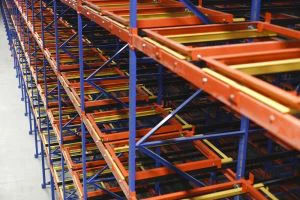
Heavy-Duty Carts & Precision Wheel Assemblies
The durability of a FILO Push Back Pallet Rack System depends on cart structural integrity and wheel assembly machining. Cheap stampings or weak bearings can lead to cart binding, uneven tracks, and unsafe operational jams.
Random Racks Storage Equipment Co., Ltd. builds nested push back carts using high-tensile structural steel tubing, cold-rolled plate components, and precision CNC-machined steel wheels fitted with sealed, low-resistance bearings. This guarantees smooth operation under full structural rating up to 1,500 kg (3,300 lbs) per pallet position.
2. Product Range & Engineering Configurations
Every facility presents unique dimensional constraints, ceiling clear heights, and inventory velocity profiles. We supply complete OEM/ODM engineered push back configurations tailored to customer requirements:
Technical Specification Matrix: Push Back Racking Options
Utilizes 1 nested cart per lane. Ideal for medium-velocity SKUs. Allows high selectivity with minimal clear height loss.
Utilizes 2 nested carts per lane. Provides an ideal balance of cube storage density and aisle space reduction.
Utilizes 3 nested carts per lane. Excellent replacement for drive-in racking in high-volume manufacturing facilities.
Utilizes 4 to 5 nested carts. Structural steel channels engineered for massive cold storage and bulk distribution centers.
3. Structural Steel Quality, Design Standards, & E-E-A-T Reliability
Safety is paramount in high-density storage systems. A failure in structural frame capacity or rail alignment can disrupt operational safety and cause major warehouse downtime. Random Racks Storage Equipment Co., Ltd. applies strict quality control processes from structural raw material selection to final export container packing:
- Steel Specification & Traceability: All upright columns, load beams, and cart channel tracks are cold-formed from certified Q235B and Q355B structural steel coils. Mill test reports (MTRs) are provided with every export shipment.
- International Compliance Standards: Our engineering team designs structures with reference to EN 15512, FEM 10.2.02, and ANSI RMI MH16.1 guidelines for pallet racking, while our shelving product lines satisfy Australian Standard AS4084 requirements.
- Third-Party Load Certification: Systems undergo rigorous load deflection tests, cycle testing, and third-party structural testing to guarantee safe operation under declared working load limits (WLL).
- Anti-Corrosive Surface Finishes: Components pass multi-stage chemical pretreatment, degreasing, and electrostatic epoxy-polyester powder coating (80–100 microns thick), offering high scratch resistance and protection against humidity and cold storage condensation.
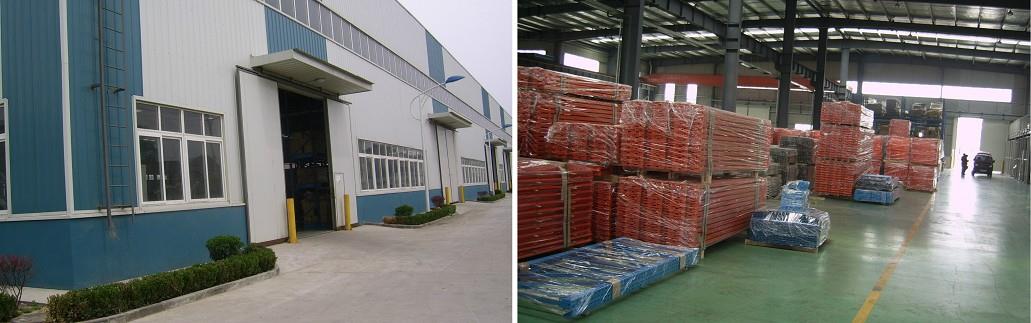
Random Racks Storage Equipment Co., Ltd. state-of-the-art manufacturing facility in Nanjing, Jiangsu Province, China.
4. Comparative Engineering Analysis: Push Back vs. Alternative Racking Systems
To help warehouse operations teams evaluate storage layout alternatives, our engineering group compiled this performance comparison matrix detailing capital cost, footprint density, and picking speeds across main high-density racking configurations:
| Racking Technology | Rotation Logic | Floor Footprint Utilization | Pallet Selectivity | Forklift Cycle Velocity | Risk of Frame Impact |
|---|---|---|---|---|---|
| FILO Push Back Racking | FILO (Last-In, First-Out) | Very High (75%-90%) | Medium (1 SKU per lane) | Fast (Aisle-Only) | Low (Truck stays in aisle) |
| Selective Pallet Rack | FIFO / LIFO | Standard (40%-50%) | 100% Direct Access | Fast | Low to Medium |
| Drive-In Racking System | FILO (Last-In, First-Out) | Very High (75%-85%) | Low (1 SKU per bay) | Slow (Enters structure) | High (Internal entry) |
| Gravity Pallet Flow Rack | Strict FIFO (First-In, First-Out) | Maximum (85%-92%) | Medium (2-aisle access) | Very Fast | Low (Separated loading) |
| Radio Shuttle Racking | FIFO or LIFO | Maximum (85%-95%) | High (Robotic deep lane) | Automated / Fast | Very Low |
5. Global Procurement Trends & Future Development (2025–2030)
As logistics automation accelerates globally, the demand for static high-density racking is evolving toward hybrid smart storage environments. Based on AI-driven supply chain search queries and direct feedback from global buyers, four major trends are shaping the future procurement of FILO push back pallet rack systems:
- Cold Chain Energy Conservation Optimization: Cold storage facilities face high power expenses. Operators are using 4-deep and 5-deep FILO push back systems inside refrigerated spaces (-25°C to -30°C) to maximize cubic meter storage volume, directly reducing per-pallet refrigeration power consumption by up to 35%.
- Hybrid AMR & Autonomous Forklift Integration: Modern distribution centers are upgrading from manually driven forklifts to Reach-Type Autonomous Guided Vehicles (AGVs) and Autonomous Mobile Robots (AMRs). Push back carts engineered by Random Racks Storage Equipment Co., Ltd. feature customized front-beam entry guides, laser target reflectors, and tight alignment tolerances to facilitate precise automated AGV loading and unloading.
- Enhanced Operator Safety Features & Sensor Telematics: Modern systems incorporate structural anti-lift safety latches, low-profile cart bumpers, and color-coded lane indicators that give operators clear visual confirmation of cart nesting depth. Next-generation push back systems are also adopting sensor-based telematics to track cart movements, monitor vibration, and schedule preventive maintenance automatically.
- Sustainable Low-Carbon Steel Supply Chains: Procurement directors increasingly demand green building compliance (such as LEED certification). Random Racks utilizes recycled structural steel content and environmentally friendly zero-VOC powder coating lines to support corporate decarbonization goals.
6. Engineering FAQs: Conversational & AI-Driven Buyer Questions
Below are clear, technical answers to common questions raised by logistics planners, warehouse operators, and global sourcing managers searching for FILO push back pallet rack systems:
Q1: How does a FILO push back pallet rack system operate?
A FILO (First-In, Last-Out) push back pallet rack system uses nested carts on inclined structural steel rails. The first pallet is loaded onto the top cart. When loading the second pallet, the forklift driver pushes the first pallet back, exposing the second cart underneath. When unloading, gravity moves the remaining pallets forward to the aisle picking face as each front pallet is removed.
Q2: What is the maximum structural depth and weight limit for push back racks?
Push back rack systems are manufactured in 2, 3, 4, 5, and 6-deep pallet configurations. Standard structural capacities range from 500 kg to 1,500 kg (1,100 lbs to 3,300 lbs) per pallet cart position. Heavy-duty custom designs engineered by Random Racks Storage Equipment Co., Ltd. can accommodate up to 2,000 kg per position upon engineering review.
Q3: What forklift types are required to operate a push back rack system?
Standard counterbalanced forklifts, reach trucks, and deep-reach trucks are fully compatible with push back systems. Because lift trucks do not enter the rack bay, special narrow-aisle masts are unnecessary unless required by overall aisle dimensions.
Q4: How do cold storage environments affect push back cart performance?
Freezing temperatures (-20°C to -30°C) can freeze standard grease and compromise low-tier bearings. Random Racks equips cold-storage push back systems with low-temperature synthetic lubricants, sealed stainless-steel bearings, and heavy-duty steel wheels to ensure continuous dynamic operation.
Q5: Can push back systems handle non-standard or damaged pallets safely?
Because pallets rest flat on full-frame steel carts rather than sliding on bare rollers, push back systems accommodate a wider range of pallet conditions (including damaged bottom boards or varying runner styles) more safely than gravity pallet flow racks.
Q6: What is the typical ROI period when upgrading to push back racking?
Most commercial distribution facilities achieve full return on investment within 12 to 18 months. ROI factors include eliminating external warehouse rentals, reducing travel times, lowering forklift maintenance costs, and preventing product damage.
7. Why Partner With Random Racks Storage Equipment Co., Ltd.?
Choosing the right manufacturer is critical when investing in customized, high-density warehouse storage systems. Random Racks Storage Equipment Co., Ltd. offers established engineering strength, robust production capacity, and dependable global project support:
Established 2004
Two decades of manufacturing experience and export projects worldwide.
Third-Party Certified
Mill test certificates and load test reports supplied for every project.
Free 3D/CAD Layout
Engineered drawings, bill of materials, and load stress analysis prior to order commitment.
Factory-Direct OEM/ODM
Tailored cart dimensions, specific RAL powder coating colors, and customized OEM branding.
Complete Project Support
Export packaging, container loading optimization, and on-site assembly guidance.