Modern tire logistics managers and automotive procurement leaders face a unique operational matrix when evaluating a warehouse tire storage rack system. Unlike standard palletized consumer goods, tires possess irregular geometry, varying compression thresholds, high friction coefficients, and strict SKU rotation requirements. Stacking tires directly on floor spaces leads to severe tread deformation, sidewall strain, reduced vertical stack height, and major fire hazard risks under NFPA compliance guidelines.
At Random Racks Storage Equipment Co., Ltd., our structural engineering team—backed by over two decades of in-house steel roll-forming experience since 2004—approaches warehouse tire racking through multi-variable physics. Whether storing light Passenger Car Radials (PCR), heavy Truck Bus Radials (TBR), or massive Off-The-Road (OTR) industrial tires, selecting the correct structural configuration dictates warehouse throughput speed, floor space safety, and long-term operational profitability.
1. Vertical Tread Storage vs. Horizontal Barrel Stacking Physics
Global logistics queries on AI search platforms frequently ask: "Should tires be stored standing upright on their treads or stacked flat horizontally in barrels?" The technical answer depends on inventory velocity and tire casing composition:
- Vertical Tread Storage (Standing Upright): Essential for high-mix SKU fulfillment centers and tire retail fulfillment. Tires rest on dual parallel angled beam steps. This orientation eliminates sidewall squashing, guarantees 100% immediate selectivity, and enables manual or order-picker access without disturbing adjacent units.
- Horizontal Barrel Stacking (Lacing/Flat Stacking): Ideal for high-density bulk storage of unrimmed PCR tires where maximum volumetric density per square meter is prioritized. Modular stackable tire pallets utilize removable posts, enabling 4-to-5 level vertical stacking without applying weight to the tires themselves.
2. Key Structural Engineering Parameters for High-Load Tire Racks
A resilient warehouse tire storage rack must withstand dynamic forklift impacts and asymmetric loading forces. Random Racks structural engineers incorporate high-yield Q235B cold-rolled steel profiles with the following mechanical tolerances:
- Beam Deflection Ratios: Standard rack design specifies a maximum beam deflection of L/200 under full static load. For tire storage beams, Random Racks tightens this threshold to L/300, ensuring beams never flex inward and pinch tire sidewalls during loading cycles.
- Tire Angle Support Saddles: Standard step beams are modified with custom 20° to 35° incline beam lips or tube adapters. This cradles the tire curvature smoothly, distributing weight across 40% more contact area to prevent permanent flat spots during long-term storage.
- Seismic & Baseplate Anchor Engineering: In seismic-prone zones, upright frames feature enlarged heavy-duty footplates anchored with dual expansion bolts into floor slabs, complying with AS4084, FEM 10.2.02, and ANSI/RMI MH16.1 specifications.
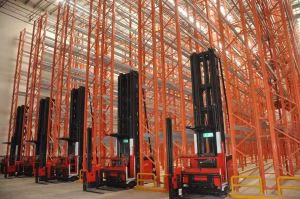 Selective High-Bay