0%

High Density Narrow Aisle Pallet Racking is becoming a practical response to rising warehouse costs and limited floor space. It uses narrower aisles, taller frames, and specialized lift trucks. The result can be more pallet positions without expanding the building. However, density alone does not guarantee better performance.

The 2024 MHI Annual Industry Report found that 83% of supply-chain professionals plan to increase technology investment during the next five years. This trend supports smarter storage designs, including very narrow aisle and guided-truck systems. CBRE’s 2024 logistics research also identified labor availability and operating costs as major warehouse concerns. A compact rack layout may help, but it can increase travel complexity and equipment dependence.

John Paxton, former CEO of MHI, described supply chains as “the backbone of our economy.” That principle applies directly here. A rack system is not merely steel and beams. It shapes replenishment speed, picker safety, forklift access, and future flexibility. Aisles may appear impressively tight. Yet one blocked position can disrupt an entire operating rhythm.

This guide examines ten High Density Narrow Aisle Pallet Racking Systems through capacity, access, installation, safety, and return-on-investment considerations. The comparison is practical rather than promotional. Some facilities may gain thousands of pallet locations. Others may discover that slower access outweighs the space savings. That uncomfortable distinction deserves attention. Reliable design begins with measured traffic data, pallet dimensions, ceiling height, and honest labor assumptions.
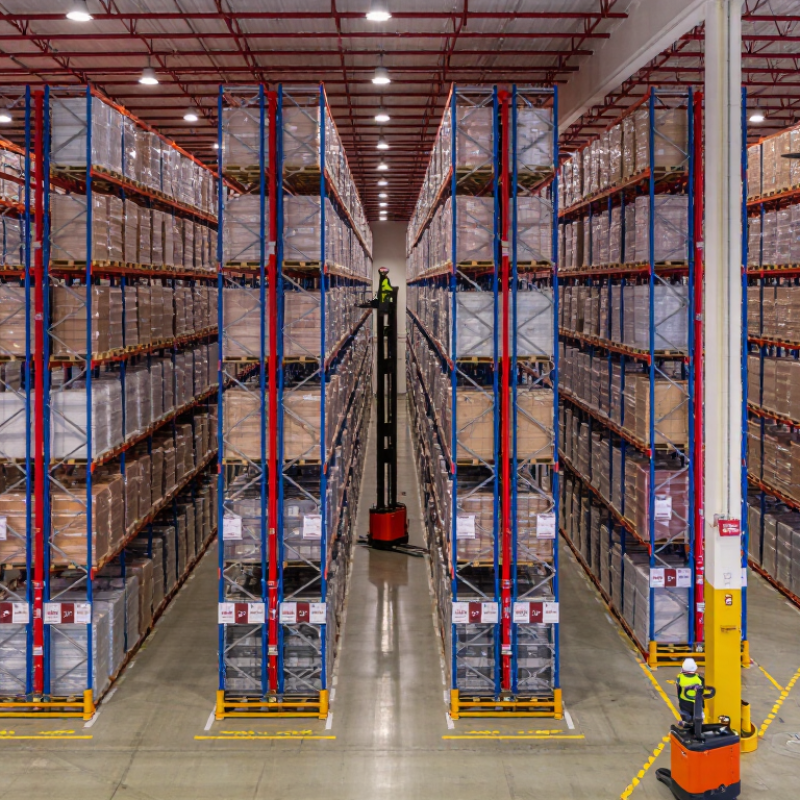
10 Best High Density Narrow Aisle Pallet Racking Systems?

What High-Density Narrow-Aisle Pallet Racking Means

High-density narrow-aisle pallet racking means storing more pallets by reducing travel space, not simply squeezing racks together. Standard warehouse aisles often measure 10 to 12 feet, while narrow-aisle layouts may use about 6 to 8 feet. Very-narrow-aisle systems can reduce this further, but they require compatible equipment, precise floor control, and trained operators. The “best” option among ten systems depends on pallet size, turnover, access requirements, and building height.

The operational gain can be substantial. A 2024 WERC DC Measures report places median order-picking accuracy near 99.5%, showing why access and control matter as much as storage density. A dense layout that slows picking may look efficient on a floor plan, yet perform poorly during peak shifts. Double-deep racks improve cube utilization, while drive-in racks support fewer stock-keeping units with larger batch quantities. Selective narrow-aisle racks offer faster access, but consume more aisle space.

In site reviews, small details often decide the result. Rack beams must match actual pallet loads, not assumed weights. Floor flatness matters for very-narrow-aisle trucks. So does emergency access. The MHI 2024 Annual Industry Report identifies labor pressure and technology investment as continuing supply-chain priorities. That supports automation, but automation is not magic. A misaligned rack still creates delays. Measuring travel distance, replenishment time, and damaged pallets before choosing a system is less impressive, but usually more reliable.

10 Best High Density Narrow Aisle Pallet Racking Systems? — What High-Density Narrow-Aisle Pallet Racking Means

How to read this chart: Narrow-aisle and very-narrow-aisle systems use less aisle space than conventional selective pallet racking, allowing more floor area to be allocated to storage. The figures shown are representative planning values; actual requirements depend on pallet size, lift-truck geometry, rack height, fire protection, and building regulations.

Key Features of the Ten Leading Narrow-Aisle Systems

High-density narrow-aisle racking can increase storage without expanding the building footprint. MHI’s 2024 Annual Industry Report found that 55% of supply-chain professionals planned to increase technology investment. That trend supports smarter rack selection, not automatic automation. Space is unforgiving.

The ten leading systems each solve a different operating problem.
Selective narrow-aisle racks provide direct pallet access and suit varied stock. Very-narrow-aisle racks use turret trucks, guide rails, and precise floor tolerances. Double-deep racks improve density, but reduce access flexibility. Drive-in racks store uniform pallets with limited rotation. Push-back racks use nested carts for last-in, first-out storage. Pallet-flow racks apply gravity rollers for first-in, first-out movement. Mobile racks place powered bases beneath conventional frames. Shuttle-assisted racks use carriers to reduce forklift travel. Automated storage and retrieval systems combine cranes, software, and controlled locations. Reach-truck layouts offer a practical bridge between standard and very narrow aisles.

WERC’s 2024 DC Measures research reinforces the importance of measurable warehouse performance, including space use, productivity, and inventory accuracy. Therefore, every design should document aisle width, clear height, pallet dimensions, beam capacity, and expected travel distance. A few centimeters can affect turning clearance. Load labels should remain visible from the operating aisle. Rack protection, end guards, and routine inspections matter, even in highly automated facilities. Fit matters. A denser layout may lower travel time, yet create congestion during replenishment. That assumption is sometimes wrong. Experienced designers test peak-hour traffic, damaged pallets, battery-changing areas, and emergency access before approving the final configuration.

How the Best Systems Compare in Storage Capacity and Access

10 Best High Density Narrow Aisle Pallet Racking Systems?

High-density pallet racking is not judged by capacity alone. Access changes the real value of every stored pallet. Drive-in racks often provide excellent density because they remove aisles, but they usually suit uniform products and last-in, first-out movement. Double-deep racks improve selectivity, although rear pallets need careful planning. Mobile racks can combine strong capacity with aisle access, but movement time and floor accuracy matter.

Very narrow aisle systems offer direct access to many pallets while using less floor space. They require specialised handling equipment, precise installation, and disciplined traffic control. Shuttle-supported storage can increase depth and reduce forklift travel. However, its performance depends on battery management, software settings, and consistent pallet quality. No system wins everywhere. A layout that looks efficient on paper may slow picking during peak hours.

Tips: Measure pallet height, load weight, and turnover before choosing a system. Compare usable pallet positions, not only quoted density. Leave enough clearance for beams, sprinklers, lighting, and safe equipment movement. Test the design with a typical daily workload. Also review damaged pallets and irregular loads; they can reduce theoretical capacity quickly. A practical site audit is valuable. Small errors become expensive.

Safety, Equipment, and Facility Requirements for Narrow Aisles

High-density narrow aisle pallet racking saves floor space, but it demands disciplined facility planning. OSHA estimates that forklifts cause about 85 workplace fatalities and 35,000 serious injuries annually in the United States. Narrow aisles can increase exposure because turning space and visibility are limited. Aisle width must match the selected truck, pallet dimensions, load overhang, and operator visibility. Manufacturer specifications alone are not enough. That assumption deserves challenge.

The Rack Manufacturers Institute recommends engineered rack design, column protection, load plaques, and regular inspections. OSHA’s 29 CFR 1910.178 also requires trained operators and safe industrial-truck practices. The floor should be level, strong, and smooth enough for stable truck travel. Small floor deviations can affect very narrow aisle equipment. Use physical barriers where pedestrians cross travel paths. Install bright, even lighting and remove blind corners. Fire protection must reflect rack height, storage materials, and building conditions. Battery charging areas need ventilation, impact protection, and controlled access. MHI’s 2024 Annual Industry Report found that 83% of supply-chain professionals expect technology investment to increase, supporting tools such as location sensors, collision alerts, and digital inspections. Technology helps. It does not replace housekeeping or human judgment. A practical audit should examine damaged uprights, blocked sprinklers, uneven pallets, and training records during normal operations, not only after an incident.

How to Select the Right High-Density Pallet Racking System

Selecting the right high-density pallet racking system starts with warehouse facts, not aisle-count promises. Record SKU dimensions, pallet weights, daily moves, turnover, and required access. A 2.4-meter aisle may improve storage density, but it can slow picking if truck maneuvering is poor. Measure lift-truck turning radii and mast heights during a real site survey. That assumption can fail.

The MHI 2024 Annual Industry Report found that 55% of supply-chain respondents expected to increase technology investment within two years. Zebra’s 2024 Warehousing Vision Study surveyed more than 1,400 warehouse decision-makers and associates, highlighting strong pressure to modernize operations. These findings support evaluating racking with vehicle guidance, inventory accuracy, and future automation in mind. Compare very-narrow-aisle, double-deep, drive-in, shuttle, and automated systems against your SKU mix. Use very-narrow-aisle racking for high selectivity and frequent access. Use drive-in designs for fewer SKUs with larger batches. Double-deep layouts save space, but they reduce immediate pallet access.

Check floor capacity, clear height, sprinkler spacing, seismic exposure, and emergency routes before approving a design. Load calculations should follow recognized engineering standards, such as ANSI MH16.1 or EN 15635, where applicable. Independent inspection matters. Leave room for damaged pallets, uneven floors, and operator mistakes. The perfect density target is rarely perfect. Recheck the design using peak-season throughput, not average daily volume.

FAQS

What does high-density narrow-aisle pallet racking mean?

It stores more pallets by reducing travel space, not by simply squeezing racks together. Aisles may measure about 6 to 8 feet. The layout still needs safe access and accurate vehicle movement.

How does narrow-aisle racking differ from standard warehouse racking?

Standard aisles often measure 10 to 12 feet. Narrow-aisle layouts use less travel space. However, tighter aisles may slow turning and picking. More storage is not always better.

Which warehouse facts should guide system selection?

Record pallet sizes, weights, SKU quantities, daily moves, turnover, and access needs. Measure truck turning radii and mast heights during a site survey. A simple aisle-count promise can fail.

When is very-narrow-aisle racking suitable?

It suits warehouses needing high selectivity and frequent pallet access. The floor must be flat and carefully controlled. Trained operators are important. Small errors matter.

When can double-deep racking improve warehouse performance?

Double-deep racking can improve cube utilization and reduce wasted floor space. It provides less immediate access than selective storage. It may work well when pallet movement is predictable. The trade-off deserves review.

What type of operation may benefit from drive-in racking?

Drive-in racking can suit fewer SKUs stored in larger batch quantities. It supports dense storage but limits immediate pallet access. It may be unsuitable for highly varied, fast-changing inventory. That detail is easy to overlook.

Does automation solve narrow-aisle warehouse problems?

Automation can support vehicle guidance, inventory accuracy, and future growth. It cannot correct a misaligned rack or uneven floor. Technology is not magic. Measure real delays before investing.

What safety and building conditions require checking?

Check floor capacity, clear height, sprinkler spacing, seismic exposure, and emergency routes. Rack beams must match actual pallet loads, not assumed weights. Independent inspection can reveal weak assumptions. Leave space for damaged pallets and operator mistakes.

How should a warehouse test its chosen racking design?

Compare travel distance, replenishment time, damaged pallets, and picking accuracy. Test the design during peak-season throughput, not average daily volume.

Conclusion

High Density Narrow Aisle Pallet Racking is designed to maximize warehouse storage capacity while maintaining organized access to palletized goods. By reducing aisle widths and using specialized lifting equipment, these systems make better use of vertical space and floor area than conventional pallet racks. The leading narrow-aisle configurations differ in accessibility, selectivity, load density, and suitability for various inventory turnover rates. Some prioritize direct access to every pallet, while others provide greater storage volume through deeper or more compact layouts.

Selecting the right system requires a careful balance between capacity and operational efficiency. Facility height, floor quality, pallet dimensions, load weight, handling equipment, fire protection, lighting, and operator training all influence performance and safety. A suitable solution should support smooth material movement, allow practical inventory control, and meet the warehouse’s long-term growth needs. By comparing storage density, access requirements, equipment investment, and facility conditions, businesses can choose a high-density pallet racking design that improves space utilization without compromising safety or productivity.

Clara

Clara

Clara is a dedicated marketing professional who combines strategic insight, clear communication, and a deep understanding of the products and services offered by our company. With a strong background in market research, content strategy, and customer engagement, she transforms complex product......