Global buyers are rethinking pallet storage as inventory variety, labor costs, and delivery expectations continue to rise. A Gravity Feed Pallet Racking System can support this shift by using inclined rollers, controlled pallet movement, and clear first-in, first-out lanes. Operators load pallets from the rear, while pickers work from the front. The layout feels simple. Its consequences are not.
MHI’s 2024 Annual Industry Report found that 55% of supply chain professionals planned to increase technology and innovation investment within two years. That figure does not guarantee a good rack selection. Warehouse geometry, pallet quality, SKU turnover, and forklift behavior still determine performance. According to David J. Piasecki, a recognized warehouse engineering author, “The best storage system is the one that supports the required workflow at the lowest total cost.” This principle matters when comparing the Top 10 Gravity Feed Pallet Racking Systems for Global Buyers.
The systems in this guide are assessed through usable capacity, lane depth, load control, replenishment speed, safety features, and installation practicality. Reports from Interact Analysis also show continuing investment in warehouse automation, but automation is not always the best answer. Sometimes, a well-designed gravity lane delivers more value than a complex solution. That judgment requires experience.
Conditions differ sharply.
Cold stores may need corrosion-resistant components. Retail warehouses may prioritize rapid case replenishment. Food distributors may require strict stock rotation and easy cleaning. No ranking can fit every facility perfectly. Buyers should verify load ratings, local standards, maintenance access, and supplier support before approving a purchase. Mistakes here are expensive, and some are difficult to reverse.
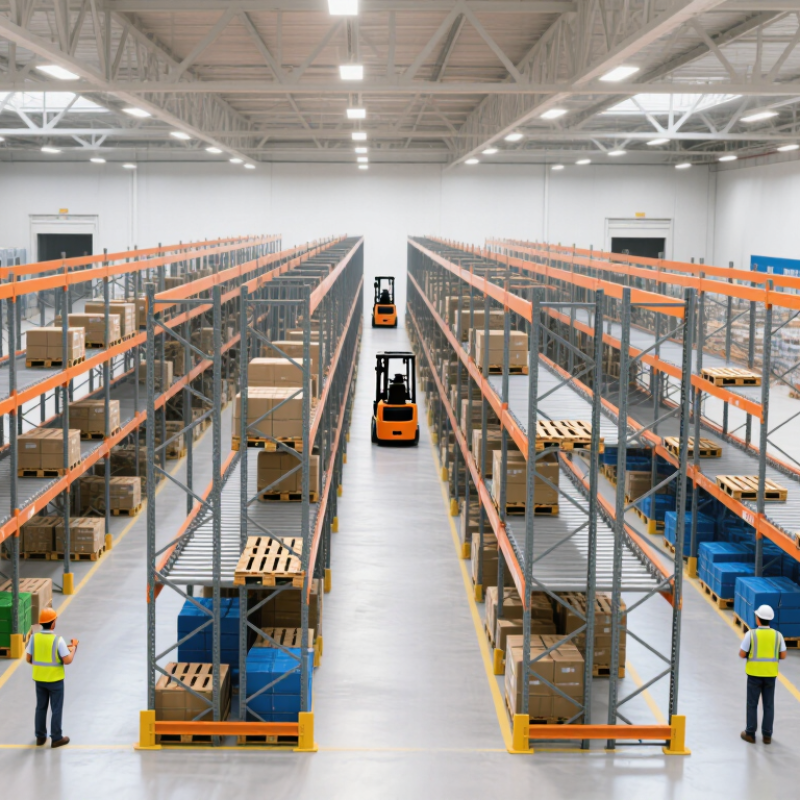
Gravity-feed pallet racking uses inclined roller lanes to move pallets without powered equipment. As one pallet leaves, gravity advances the next load toward the picking face. The result is compact storage, but design details determine whether movement remains controlled.
FIFO lanes load pallets from the rear and pick them from the front. This approach supports dated goods, stock rotation, and clearer inventory visibility.
LIFO lanes load and pick from the same side. They can simplify access and increase density, but older pallets may remain hidden. That matters. A warehouse handling mixed products should not assume one method fits every lane.
Six- to eight-deep lanes offer strong space efficiency for uniform pallets. They require consistent pallet dimensions, suitable roller spacing, correct lane slope, and controlled entry speed. Brake rollers or speed-control devices can reduce impact at the picking position. Small errors become expensive. A slightly damaged pallet may stop several loads behind it. Buyers should request load calculations, sample pallet testing, and maintenance access before approval. Qualified engineers should also verify local safety requirements and floor capacity. Even careful layouts need review after installation, because real pallet conditions rarely match drawings perfectly.
When comparing the top 10 gravity feed pallet racking systems, global buyers should examine safety evidence before price. EN 15635 requires competent inspection at least every 12 months. It also supports more frequent visual checks, especially in busy warehouses. A damaged frame is not a minor cosmetic issue.
RMI MH16.1 provides engineering guidance for rack design, stability, connections, and rated capacity. Buyers should request signed load data, not verbal promises. Check beam spans, pallet weight, impact loads, seismic assumptions, and floor strength. The published EN 15635 guidance also stresses clear load notices and documented inspections. Yet, many purchasing teams still compare only storage density. That is a weak decision.
Tips: Photograph every damaged upright and label its location. Keep inspection records beside the layout drawing. Confirm whether load ratings change after adding wheel beds, guides, or safety accessories. A practical trial can reveal pallet drag, uneven loading, and poor first-in-first-out flow. Use calibrated measuring tools where possible. Small errors accumulate. Review the data with a qualified structural engineer, because local building rules may add stricter requirements. Sources: EN 15635, Steel Static Storage Systems; RMI MH16.1, Specification for the Design, Testing and Utilization of Industrial Steel Storage Racks.
Top 10 Gravity Feed Pallet Racking Systems for Global Buyers
The ranking below weighs storage density, pallet throughput, and operator access. It reflects practical warehouse design, not catalog claims.
1. Full-width pallet flow: highest density for fast-moving, uniform SKUs.
2. Narrow-lane pallet flow: strong density with better aisle access.
3. Carton-supported pallet flow: useful for mixed cases and replenishment.
4. FIFO live storage: supports date-sensitive inventory and clear rotation.
5. Push-back flow: excellent density, but deeper lanes reduce direct access.
6. Two-deep gravity lanes: balanced throughput and moderate selectivity.
7. Three-deep lanes: more density, with slower rear-pallet access.
8. Mobile gravity lanes: flexible capacity, but higher structural complexity.
9. Pallet-flow mezzanine layouts: improve vertical use and picking separation.
10. Hybrid gravity systems: combine FIFO and push-back zones for varied demand.
MHI’s 2024 Annual Industry Report found that 55% of respondents planned to increase technology investment. Gravity systems can support that shift without removing every manual task. A loaded pallet should roll smoothly, stop safely, and remain visible from the aisle. Small wheel resistance can become a serious bottleneck. Real warehouses are less perfect.
Tips: Measure pallet weight, bottom-board quality, SKU velocity, and replenishment frequency before selecting lane depth. Test the heaviest pallet and the slowest-moving SKU. Confirm clearances with trained rack inspectors. WERC’s distribution-center benchmarking work also supports comparing travel time, order accuracy, and labor productivity, rather than density alone. Access still matters. A dense lane that requires frequent reshuffling may lose its expected savings. Review performance after seasonal peaks, when congestion reveals design weaknesses.
Ranked by storage density, throughput, and pallet access
The chart compares common gravity-feed pallet-racking configurations using typical engineering benchmarks. Storage density is shown as usable pallet positions per floor area, throughput represents pallet movements per hour, and access is scored from 1 to 10 based on selectivity and retrieval convenience. Actual performance varies with pallet dimensions, load weight, lane length, forklift type, and warehouse operating practices.
Top 10 Gravity Feed Pallet Racking Systems for Global Buyers
Capacity Comparison: Up to 60% More Storage Within the Same Footprint
Gravity feed pallet racking can increase storage density without expanding the warehouse shell. In practical layouts, savings may reach 60% compared with conventional selective racks. The result depends on aisle width, pallet size, beam levels, and loading equipment. Every project differs.
The strongest systems use inclined roller lanes to move pallets toward the picking face. This reduces forklift travel and keeps inventory visible. A 30-meter storage run can hold several pallets in depth, while the front position remains accessible. Separating loading and unloading sides also improves product flow. Small details matter.
However, the “up to 60%” figure deserves careful review. Fire protection, structural limits, local seismic conditions, and damaged pallets can reduce usable capacity. A low-cost design may look efficient on paper. It may perform poorly during peak receiving hours. Experienced buyers should request load calculations, lane tests, maintenance access, and clear installation tolerances. Site measurements should include columns, doors, sprinklers, and floor levels. One overlooked obstruction can erase expected gains.
| No. | System Configuration | Operating Principle | Typical Pallet Load | Recommended Lane Depth | Storage Selectivity | Typical Space Gain* | Best-Fit Inventory | Pallet Flow Direction |
|---|---|---|---|---|---|---|---|---|
| 1 | Single-deep pallet flow rack | Pallets move on gravity rollers from the loading side to the picking side. | 500–1,500 kg | 2–6 pallets | High | 20–35% | Fast-moving, date-sensitive goods | FIFO |
| 2 | Double-deep carton-supported pallet flow | Two pallet positions are arranged behind each other on inclined roller lanes. | 600–1,500 kg | 4–8 pallets | Medium–High | 30–40% | Uniform SKUs with stable demand | FIFO |
| 3 | Deep-lane pallet flow rack | Long gravity lanes consolidate multiple pallets of the same SKU. | 800–1,500 kg | 6–12 pallets | Low–Medium | 40–55% | High-volume reserve inventory | FIFO |
| 4 | Pallet live storage with brake rollers | Controlled-speed rollers regulate pallet travel on inclined lanes. | 500–1,500 kg | 3–10 pallets | High | 25–45% | Fragile or mixed-weight pallet loads | FIFO |
| 5 | Pallet flow rack with automatic load separation | Mechanical separators maintain a controlled gap between moving pallets. | 600–1,500 kg | 4–10 pallets | High | 30–50% | High-throughput distribution operations | FIFO |
| 6 | Push-back gravity rack with nested carts | Forklifts place pallets on carts that roll backward as additional pallets are loaded. | 800–1,500 kg | 2–6 pallets | Medium | 30–50% | Medium- to slow-moving reserve stock | LIFO |
| 7 | Push-back gravity rack with roller rails | Pallets roll on inclined rails and are retrieved from the same aisle. | 500–1,500 kg | 2–5 pallets | Medium | 25–45% | SKU groups requiring compact reserve storage | LIFO |
| 8 | Pallet flow rack with pick-face replenishment | Reserve pallets feed forward-facing picking positions by gravity. | 300–1,200 kg | 2–5 pallets | High | 20–40% | Case-picking and order-fulfillment stock | FIFO |
| 9 | Temperature-controlled pallet flow rack | Gravity lanes maximize cube utilization inside chilled or frozen storage areas. | 500–1,500 kg | 3–10 pallets | High | 35–60% | Frozen food, dairy, meat and pharmaceuticals | FIFO |
| 10 | High-density multi-level gravity flow rack | Multiple vertical rack levels combine deep gravity lanes with dedicated loading and unloading aisles. | 800–1,500 kg | 6–12 pallets | Low–Medium | 45–60% | Large-volume, palletized, low-SKU-count inventory | FIFO or LIFO |
Selecting among the top 10 gravity feed pallet racking systems starts with the SKU profile, not the catalog photograph. Fast-moving, date-sensitive pallets often suit FIFO lanes with rollers and controlled unloading. Slow-moving products may perform better in denser configurations. Record pallet length, load weight, daily movements, and lane depth. Small differences matter.
Forklift requirements shape the matrix. Counterbalance trucks need wider approach aisles than reach trucks. Measure mast height, turning radius, fork length, and maximum lift height. Check whether the forklift can place pallets without striking guide rails. It sounds obvious. It is often missed. Include damaged pallets and uneven floors in the assessment, because real warehouses rarely match the drawing.
Regional codes require local verification before installation. Seismic zones may require stronger bracing and anchoring. Fire regulations can affect flue spaces, sprinkler clearance, and storage height. Workplace rules may define aisle widths, rack protection, inspections, and load notices. Use calculations signed by a qualified engineer where required. A warehouse layout approved in one country may fail another authority’s review. Cost comparisons should include engineering, permits, floor reinforcement, training, and periodic inspections. My own selection logic would still leave one uncomfortable question: is maximum density worth slower replenishment or harder maintenance access?
It uses inclined roller lanes to move pallets by gravity. As one pallet leaves, another moves toward the picking face. No powered conveyor is required. Movement still needs control.
Pallets enter from the rear and leave from the front. This supports dated goods and clearer stock rotation. It keeps older inventory from hiding behind newer pallets. That matters for time-sensitive products.
LIFO loads and retrieves pallets from the same side. It can simplify access and increase storage density. However, older pallets may remain behind newer ones. That trade-off deserves review.
No. They work best with uniform pallets, consistent weights, and steady dimensions. Roller spacing, lane slope, and entry speed must match the loads. A damaged pallet can stop several pallets behind it.
They may provide up to 60% more storage within the same footprint. The result depends on aisle width, pallet size, levels, and equipment. Sprinklers, columns, seismic requirements, and floor limits reduce usable capacity. The headline number is not a promise.
Record pallet length, width, weight, movements, and lane depth. Measure forklift turning radius, fork length, mast height, and lift height. Include doors, columns, sprinklers, and floor irregularities. Drawings often miss inconvenient details.
Brake rollers or speed-control devices can reduce impact at the picking face. Controlled loading also helps prevent sudden pallet movement. Roller spacing must support the pallet structure. Small errors become expensive.
Request load calculations, sample pallet testing, and maintenance access. A qualified engineer should verify floor capacity and local requirements. Check bracing, anchoring, aisle widths, flue spaces, and storage height. Periodic inspections remain necessary.
Not necessarily. Dense storage can reduce aisle space and complicate replenishment. Maintenance access may become slower during busy receiving periods. I would question density gains that make daily work awkward.
A Gravity Feed Pallet Racking System uses inclined roller lanes to move pallets through controlled gravity, supporting either FIFO or LIFO inventory strategies. With typical lane depths of six to eight pallets, these systems can improve storage density, product flow, and picking efficiency while keeping loading and unloading activities organized. Compared with conventional selective storage, a well-designed layout may provide up to 60% more capacity within the same footprint, depending on pallet dimensions, product characteristics, and aisle planning.
For global buyers, safety and compliance should be central to system selection. Important considerations include EN 15635, RMI MH16.1, verified load data, rack protection, inspection procedures, and local regional codes. The best solution depends on SKU turnover, pallet stability, temperature conditions, forklift type, lane depth, and required throughput. A practical selection matrix can help compare the top ten system configurations by density, accessibility, operational speed, installation requirements, and long-term maintenance needs.