Featured Warehouse Storage & Automated Shuttle Systems
High-performance pallet racking, semi-automated shuttle vehicles, and structural multi-tier platforms manufactured under ISO 9001 & CE safety compliance.
1. Executive Summary: Engineering Standards for CE Certified Radio Shuttle Systems
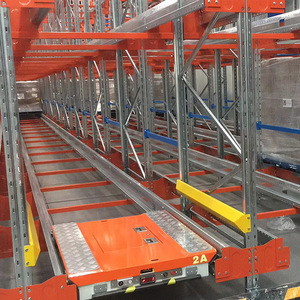
Modern intralogistics demands maximum volumetric storage efficiency, minimal operator risk, and seamless integration with Enterprise Resource Planning (ERP) and Warehouse Management Systems (WMS). Among high-density storage solutions, CE Certified Radio Shuttle Cart Systems (also referred to as automated pallet runners or shuttle racking carts) represent the optimal evolution beyond legacy Drive-In and Push-Back racking architectures.
By delegating horizontal pallet transportation inside deep storage channels to a self-propelled, remote-controlled (or fully autonomous WCS-guided) shuttle cart, warehouse operators eliminate the necessity for forklifts to enter structural racking aisles. This structural separation dramatically reduces rack damage, enhances operational throughput by up to 200%, and increases cube storage utilization to over 85% of total warehouse volume.
Technical Insight: CE Certification under the Machinery Directive 2006/42/EC and EN 15095 mandates that automated radio shuttle carts feature dual redundant safety systems, obstacle-sensing LiDAR/infrared sensors, emergency braking mechanisms, and electro-magnetic compatibility (EMC) to guarantee zero-accident operation in high-throughput fulfillment environments.
When selecting a CE Certified Radio Shuttle Cart Manufacturer, enterprise buyers must evaluate mechanical structural integrity, lithium battery cell stability (LiFePO4 chemistry), drive mechanism efficiency, laser-guided positioning tolerances, and real-time wireless communication protocols (RF 433MHz, 868MHz, or Wi-Fi 2.4G/5G networks).
2. Core Technical Architecture of High-Density Pallet Shuttle Carts
A high-performance radio shuttle cart combines heavy-duty electro-mechanical engineering with sophisticated micro-controller PLC logic. Below are the key structural components engineered by top-tier racking factories:
LiFePO4 Power Management
High-capacity Lithium Iron Phosphate (LiFePO4) battery packs engineered for fast charging (under 3 hours) and extended operational duty cycles exceeding 8 to 10 hours continuous motion. Built-in BMS safeguards against overcharging, deep discharge, and thermal runaway.
Dual-Laser Obstacle Detection
Front and rear photoelectric sensors and safety laser scanners compliant with ISO 13849-1 (PLd level). Automatically slows down and stops the cart within 50mm of detecting obstacles, misplaced pallets, or maintenance personnel in the aisle.
Siemens / Omron PLC Controls
Industrial-grade Programmable Logic Controllers (PLC) handling millisecond positioning feedback, optical encoder tracking, automatic pallet distance spacing, and dynamic acceleration/deceleration curves to prevent load tipping.
Electro-Hydraulic Lift Mechanism
Heavy-duty hydraulic platform lifting system capable of smoothly raising pallet loads up to 1,500 kg (3,300 lbs) in less than 2.5 seconds, ensuring low mechanical wear and zero hydraulic fluid leaks under high pressure.
Deep Freeze (-30°C) Resilience
Specialized low-temperature electrical components, anti-freezing lubricants, heated display panels, and moisture-sealed IP65 electronic enclosures specifically engineered for cold chain and frozen food logistics.
Multi-Pallet Size Adaptability
Configurable wheel-base sensors and adjustable channel guide runners that accommodate Euro-pallets (800x1200mm), Industrial pallets (1000x1200mm), and custom chemical/beverage skids on the same racking system.
Engineering Specification Matrix: Radio Shuttle Cart Benchmark Parameters
The following technical parameters outline the industrial standard requirements for heavy-duty CE certified radio shuttle carts used in enterprise warehousing:
| Performance Characteristic | Standard Duty Model | Heavy-Duty Cold Storage Model | Automated WCS 4D Shuttle |
|---|---|---|---|
| Rated Load Capacity | 500 kg - 1,000 kg | 1,200 kg - 1,500 kg | 1,000 kg - 2,000 kg |
| Unloaded Travel Speed | 1.0 m/s – 1.2 m/s | 1.1 m/s – 1.3 m/s | 1.5 m/s – 2.0 m/s |
| Loaded Travel Speed | 0.7 m/s – 0.9 m/s | 0.8 m/s – 1.0 m/s | 1.0 m/s – 1.2 m/s |
| Operating Temperature | -10°C to +45°C | -30°C to +40°C | -25°C to +50°C |
| Lifting Time / Lowering Time | 2.5 s / 2.0 s | 2.8 s / 2.2 s | 1.8 s / 1.5 s |
| Battery System | 24V / 60Ah LiFePO4 | 24V / 80Ah Heated LiFePO4 | 48V / 100Ah Fast-Charge Lithium |
| Continuous Battery Life | 8 - 10 Hours | 8 - 12 Hours (with thermal management) | 24/7 (via auto-docking stations) |
| Wireless Control Interface | Industrial Handheld Remote (433MHz) | Rugged Tablet / RF Control | 5G / Wi-Fi Seamless Roaming (WCS API) |
| Safety Certification | CE, ISO9001, RoHS | CE (2006/42/EC), EN 15095, FEM 10.2.02 | CE, ISO 13849-1 PLd, TÜV Rheinland |
3. Future Procurement & Technology Trends in Shuttle Automation
The global warehouse automation market is undergoing a rapid transition toward intelligent, self-learning material handling environments. When procuring radio shuttle systems over the next decade, supply chain executives and logistics directors should factor in the following four macro trends:
3.1 Transition from 2D Semi-Automation to 4D Multi-Directional Shuttle Fleet Solutions
While traditional 2D radio shuttles travel exclusively in a single deep channel (requiring a forklift operator to relocate the shuttle between channels), 4D Multi-Directional Pallet Shuttles feature dual-axis movement capability. Equipped with internal wheel-change mechanisms, 4D shuttles transition seamlessly across channels and main longitudinal aisles without manual intervention. Integrated with automated vertical elevators (lifts), 4D shuttle networks form fully automated AS/RS (Automated Storage and Retrieval Systems) that run 24/7 with zero forklift labor.
3.2 5G-IoT Connectivity and Edge-Computing Diagnostics
Modern CE-certified shuttle carts are increasingly integrated with 5G private network modules and Industrial Internet of Things (IIoT) sensor suites. Real-time telemetry data—including motor temperature, wheel friction coefficients, battery state-of-health (SoH), laser optic cleanliness, and alignment accuracy—is continuously streamed to cloud-based predictive maintenance dashboards. Procurement teams can now minimize unscheduled downtime by replacing worn bearings or recalibrating optical sensors before an operational failure occurs.
3.3 Cold Chain ESG Efficiency & Carbon Footprint Reduction
Energy consumption in temperature-controlled refrigerated warehouses represents one of the highest operational expenditures for 3PL logistics providers. Radio shuttle systems allow cold storage operators to reduce clear bay height allowances, compress building footprints by up to 50% compared to selective rack layouts, and decrease cooling air escape volumes. High-efficiency brushless DC motors combined with regenerative braking systems (capturing kinetic energy during shuttle deceleration) reduce total electrical power consumption by up to 30% per pallet movement.
3.4 Direct WMS/WCS Integration via Open RESTful APIs
Proprietary closed-loop remote controls are rapidly giving way to open-architecture Warehouse Control System (WCS) software platforms. Leading CE certified shuttle cart manufacturers provide standardized RESTful APIs, MQTT messaging protocols, and CANopen bus interfaces. This enables logistics software engineers to bridge shuttle fleets directly with SAP, Manhattan Associates, Infor, or custom proprietary WMS platforms, empowering automated FIFO (First-In, First-Out) or LIFO (Last-In, First-Out) inventory rotation with zero human data entry errors.
Request a Custom 3D CAD Layout & Engineering Proposal
Planning a new warehouse facility or converting selective pallet racks to an automated radio shuttle system? Our senior structural engineers deliver fully optimized 3D CAD designs and bill of materials within 24 hours.
4. Random Racks / Factory OEM Strengths & Compliance Standards
Founded in 2004, Random Racks Storage Equipment Co., Ltd. (also operating under the established OTS Racking brand registered in 2012) stands among China's premier heavy-duty warehouse racking manufacturers and automated storage system engineers. Headquartered in the Guli Industry Zone, Jiangning District, Nanjing, our advanced manufacturing facility covers extensive production acreage equipped with automated cold-roll forming lines, robotic welding cells, and continuous electrostatic powder coating tunnels.
Manufacturing Rigor & Quality Management Systems
Every radio shuttle racking frame, beam, and guide rail is manufactured strictly from certified structural steel coils (SS400, Q235B, Q355B high-tensile steel) accompanied by full mill test certificates (MTC). Our internal Quality Control (QC) laboratory performs continuous structural testing, including:
- Structural Deflection & Load Capacity Testing: Verified under FEM 10.2.02 and EN 15512 structural design codes.
- Coating Adhesion & Anti-Rust Salt Spray Testing: Premium epoxy powder finishes subjected to 500+ hours of neutral salt spray testing to guarantee rust immunity in humid environments.
- Weld Integrity Micro-Inspection: Robotic MIG/MAG ultrasonic weld inspection ensuring zero internal porosity on heavy load-bearing beam connectors and column baseplates.
- AS4084 Structural Compliance: Full compliance with Australian Standard AS4084-2012 for industrial steel storage racking.
End-to-End International OEM/ODM Service
We provide full-spectrum engineering support for international system integrators, rack distributors, and logistics warehouse operators worldwide. From initial floor plan auditing and floor slab point-load calculations to customized brand color-matching, custom packaging for ocean freight container optimization, and on-site commissioning supervision—Random Racks ensures guaranteed project execution on schedule.
5. Enterprise Buyer Procurement FAQ (Frequently Asked Questions)
Below are technical answers to the most common queries raised by warehouse managers, structural engineers, and procurement specialists when evaluating radio shuttle cart suppliers:
Why is CE Certification essential for radio shuttle carts?
CE Certification confirms that the radio shuttle cart complies with all essential health and safety requirements of the European Machinery Directive (2006/42/EC), Low Voltage Directive (2014/35/EU), and Electromagnetic Compatibility Directive (2014/30/EU). For facility owners, CE compliance ensures that the machinery incorporates safe electrical insulation, emergency stop circuits, laser obstacle detection, and operator hazard protection—reducing corporate liability and ensuring compliance with local workplace safety regulations (such as OSHA in the US or WorkSafe in Australia).
How do I determine whether to choose FIFO or LIFO operating mode for shuttle racking?
The choice between FIFO (First-In, First-Out) and LIFO (Last-In, Last-Out) depends on inventory rotation policy and building geometry. LIFO requires only one access aisle at the front of the racking block, making it ideal for non-perishable goods, fast-moving consumer goods (FMCG) with uniform SKUs, and deep-lane cold storage. FIFO requires an entry aisle at the rear for loading and a dedicated front aisle for retrieval, making it necessary for date-sensitive perishable food, pharmaceuticals, and products with strict batch tracking.
What floor levelness and slab load capacities are required for shuttle rack installation?
Because shuttle racking concentrates heavy pallet loads across tall upright profiles without inter-aisle spacing, floor slab design must be verified prior to installation. Concrete floors should conform to FM2 or Superflat tolerances (ISO 18300 / DIN 18202 Class 3). Structural slab thickness typically requires reinforced concrete of 200mm to 300mm with a minimum compressive strength of 30 N/mm² (C30/37 grade) to withstand column point-loads that can exceed 80 to 120 kN per baseplate.
How does a radio shuttle cart perform in cold storage and blast freezer environments?
Standard electronic carts experience severe battery drainage and condensation short-circuits below 0°C. Cold-chain certified radio shuttle carts utilize specialized low-temperature LiFePO4 batteries equipped with internal thermostat-controlled heating jackets, synthetic low-viscosity gear lubricants, IP65 sealed control boards, and stainless steel fasteners. This enables smooth, uninterrupted operation down to -30°C (-22°F) without loss of speed or lifting force.
Can your factory design a custom shuttle system based on existing warehouse CAD drawings?
Yes. Simply send us your warehouse architectural drawings (DWG/PDF format), including clear building height under trusses, location of building columns, door placements, floor slab details, pallet dimensions (W x D x H including overhang), maximum unit load weights, and your forklift mast lift height capabilities. Our engineering department returns a detailed 3D CAD layout, channel capacity breakdown, and complete price quotation free of charge.
What is the average production lead time and international delivery protocol?
Standard manufacturing lead time for custom structural shuttle racking profiles and radio shuttle cart units is 15 to 25 calendar days following technical drawing approval. Products are bundled with steel strapping, wrapped in protective moisture-barrier film, and loaded into 20GP or 40HQ sea containers. Detailed installation drawings, assembly video tutorials, and remote engineering guidance are provided with every shipment.
What design codes do your racking structures follow for global export?
Our heavy-duty steel pallet racks are engineered in accordance with international structural design codes: EN 15512 and FEM 10.2.02 for European markets, AS4084-2012 for Australia and New Zealand, and RMI (Rack Manufacturers Institute) guidelines for North America. Independent third-party load test reports from SGS or TÜV are available upon request.
What maintenance procedures are required to ensure long battery and cart lifespan?
Routine maintenance is straightforward: inspect optical sensor lenses monthly and wipe clear of dust; check drive wheel polyurethane treads every 6 months for excessive wear; verify frame fastener torque settings annually; and store lithium battery units at 50% charge state if the system is shut down seasonally. Modern shuttles feature automated diagnostic codes displayed on the handheld controller or WCS interface to instantly pinpoint any sensor or motor anomaly.
Connect With Our Automated Storage Engineers Today
Partner direct with an experienced Chinese racking manufacturer founded in 2004. Get factory-direct pricing, certified steel quality, and expert technical support for your warehouse automation project.