Featured Industrial Storage & Handling Systems
Engineered for high load-bearing precision, automated integration, and maximum vertical cube utilization.
1. Executive Summary & Structural Engineering Foundations
In the contemporary landscape of global supply chain management, optimizing volumetric warehouse efficiency while safeguarding structural integrity remains a mission-critical objective for logistics directors and procurement executives. As a premier China stacking storage crate supplier & exporter, Random Racks Storage Equipment Co., Ltd. (operating with advanced manufacturing infrastructure in Nanjing, Jiangsu, China since 2004) delivers high-performance material handling units, customized metal stillages, wire containers, gravity flow racks, and multi-tier structural mezzanine systems.
Modern industrial warehousing demands rigorous mechanical metrics. Stacking storage crates and modular steel stillages are no longer mere passive transport containers; they are integral load-bearing modules designed to seamlessly interface with Automated Guided Vehicles (AGVs), Automated Storage and Retrieval Systems (AS/RS), and high-reach turret trucks. Yield strength, dynamic load capacities, fatigue limits under cyclic loading, and electrostatic powder coating performance define the boundary between operational efficiency and cataclysmic structural failure.
| Material / Specification Metric | Standard Compliance | Technical Engineering Parameter | Operational Advantage |
|---|---|---|---|
| Primary Steel Composition | GB/T 700 Q235B / Cold-Rolled | Yield Strength $f_y \ge 235 \text{ MPa}$, Tensile Strength $f_u = 370\text{--}500 \text{ MPa}$ | Prevents structural deformation under extreme vertical compression up to 2,000 kg/unit. |
| Surface Treatment Finishes | ISO 9227 Salt Spray Test | Thermosetting Epoxy Electrostatic Powder Coat (60–80 μm) or Hot-Dip Galvanizing | Resists atmospheric oxidation, chemical exposure, and humidity in cold storage environments down to -30°C. |
| Design Standard Compliance | AS4084-2012, EN 15512, FEM 10.2.02 | Finite Element Analysis (FEA) verified elastic-plastic structural modeling | Guarantees safety factors ranging from 1.5 to 1.95 under maximum dynamic and static load configurations. |
| Stacking Safety Index | ISO 8611 Load Test Protocols | 4-High Fully Loaded Static Stacking Alignment with Interlocking Lug Locks | Eliminates lateral slippage and tipping hazards during vertical warehouse stacking without racking. |
2. Technical Deep Dive: Stacking Crates, Wire Containers & Flow Systems
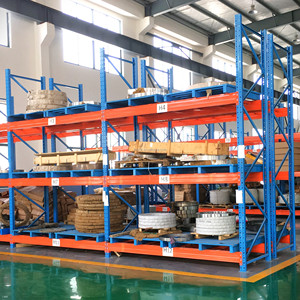
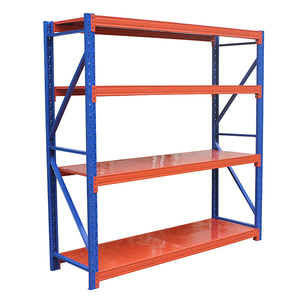
To achieve high-density storage without sacrificing inventory selectivity, procurement managers must match specific structural systems to their throughput requirements. Below is an engineering evaluation of core industrial storage formats offered by China’s leading export manufacturing facilities.
Collapsible Wire Mesh Stillages
Constructed with cold-drawn Q195/Q235 steel wire (diameter 4.8mm to 6.4mm) mesh welded at every intersection. Features drop-gate access for manual order picking and cupped feet for secure 4-high vertical stacking.
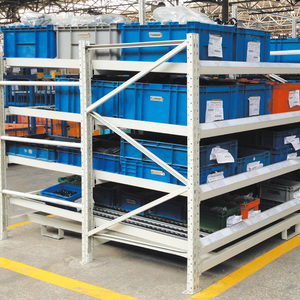
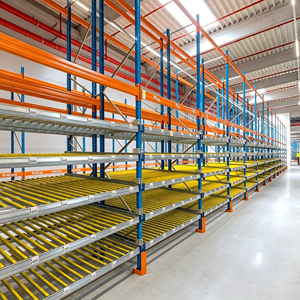
Gravity Carton & Pallet Flow Racks
Utilizes inclined roller tracks (3–5 degree angle) equipped with magnetic speed controllers and separation brakes. Operates strictly under First-In, First-Out (FIFO) mechanics, making it ideal for date-sensitive SKUs.
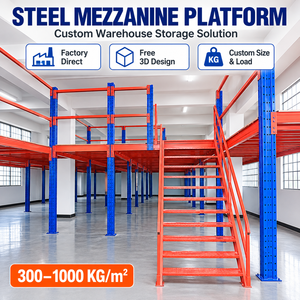
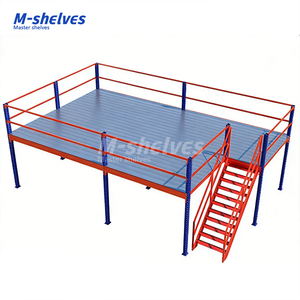
Multi-Tier Steel Mezzanines
Heavy-duty platform structures designed using structural H-beams and cold-formed upright profiles. Converts unused overhead airspace into actionable operational picking floors or office space.
2.1 Mechanics of Heavy-Duty Metal Stacking Crates
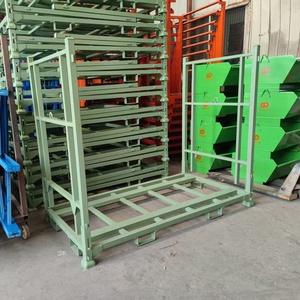
Industrial stacking storage crates rely on precise cold-rolled profile forming. Unlike standard injection-molded plastic totes, heavy-duty metal storage crates and stillages maintain structural rigidity under extreme environmental stress. The perimeter frames are engineered with tubular steel sections or folded channel steel, reinforced by corner post assemblies capable of bearing combined axial loads exceeding 6,000 kg when stacked four units high.
The interlocking mechanism is the pivot point of structural stability. Premium Chinese manufacturers incorporate precision-stamped steel stacking feet that cup onto the top rim or post caps of the underlying crate. This geometric locking mechanism mitigates shear stress caused by minor ground inclinations, crane vibrations, or forklift impacts.
2.2 Gravity Flow Racking & FIFO Inventory Control
Order fulfillment centers handling rapid-turnover fast-moving consumer goods (FMCG), e-commerce parcels, and automotive components utilize gravity carton flow racks to separate stocking lanes from picking lanes. Incorporating high-impact plastic or steel cylindrical rollers set within a structural steel frame, these systems allow cartons to glide effortlessly from the loading face to the picking face.
Engineering parameters for gravity flow lines require rigorous calculations: kinetic friction coefficients must be counterbalanced by engineered brake rollers to avoid momentum accumulation. When heavy storage crates or cartons accelerate along lanes exceeding 4 meters in depth, internal centrifugal or eddy-current brake assemblies regulate speed to a controlled rate ($v \le 0.3 \text{ m/s}$), preventing impacts at the picking discharge point.
3. Global Procurement Trends in Stacking Crates & Warehouse Equipment (2025–2030)
As enterprise supply chains shift toward high resilience, automation, and environmental accountability, strategic sourcing parameters for warehouse equipment are evolving rapidly. Procurement buyers must align their technical tenders with key global macro trends:
Trend A: Seamless AGV & AMR Robotic Interfacing
The integration of Autonomous Mobile Robots (AMRs) and Automated Guided Vehicles (AGVs) requires strict manufacturing tolerances on stacking crates and metal pallets. Traditional manual handling allowed for dimensional variances of $\pm 5\text{ mm}$; modern robotic end-effectors require dimensional repeatability within $\pm 1.5\text{ mm}$. Exporters are upgrading to robotic laser welding and automated CNC brake presses to ensure consistent crate geometry across thousands of production runs.
Trend B: Modular Hybrid Warehousing Infrastructure
Fixed racking installations are increasingly being supplemented or replaced by modular, movable stacking crates and post pallets. Flexible supply chain nodes require the ability to rapidly convert open floor space into high-density storage zones during seasonal peaks, and dismantle the entire setup when operational requirements shift. Foldable wire stillages and demountable post racks provide maximum space recovery when returned empty, saving up to 75% in return-freight cubic volume.
Trend C: Sustainable Circular Lifecycle & Carbon Accounting
Scope 3 carbon emission accounting is driving global buyers to replace single-use timber pallets and short-life plastic containers with 100% recyclable steel storage crates. Fully welded structural steel crates offer an operational lifespan exceeding 15 years. When finished with eco-friendly non-VOC thermosetting powder coatings or zinc galvanization, steel containers represent the lowest cradle-to-grave environmental impact per logistics cycle.
4. Product Development & Material Engineering Trends
Continuous metallurgical research and surface engineering have unlocked significant performance improvements for industrial metal crates and warehouse racking systems engineered in China:
- Micro-Alloy High-Strength Steels (HSLA): By introducing micro-alloying elements such as Niobium (Nb) and Titanium (Ti), steel mills are producing cold-rolled coils with elevated yield thresholds. This allows manufacturers to reduce gauge thickness by 12–15% without sacrificing tensile load capacity, lowering tare weight and freight costs.
- Smart Sensor & RFID Embedded Crates: Stacking crates are increasingly produced with recessed protective brackets engineered to house passive or active RFID tags, IoT asset trackers, and BLE beacons. This facilitates real-time inventory localization within high-bay distribution centers without manual barcode scanning.
- Nanocomposite & Duplex Anti-Corrosion Finishes: For applications in marine shipping, chemical manufacturing, and sub-zero cold storage facilities, conventional paint finishes are insufficient. Advanced factories utilize a duplex system: an automated zinc phosphate pre-treatment layer followed by an electrocoat (E-coat) primer and a topcoat of high-durability polyester powder. This system withstands over 1,000 hours of continuous ASTM B117 salt spray testing without sub-film corrosion.
5. Total Cost of Ownership (TCO): Direct Factory Export vs. Local Distributors
When sourcing industrial stacking crates and warehouse racking equipment, global buyers often face a strategic decision: source directly from a certified Chinese manufacturer or purchase via localized third-party stocking distributors. The engineering TCO model below illustrates the direct economic advantages of factory-direct OEM/ODM procurement:
| Cost Element / Evaluation Vector | Direct China Factory Procurement (Random Racks) | Regional Middleman / Local Distributor |
|---|---|---|
| Initial Procurement Unit Cost | Direct Factory Pricing (Zero distributor markup) | High Markup (+35% to +60% margin stack) |
| Dimensional & Engineering Customization | Full OEM/ODM engineering customization via 3D/CAD modeling | Restricted to standard catalog sizes and off-the-shelf units |
| Material Traceability & QA Certification | Direct Mill Test Certificates (MTC) and third-party load reports | Secondary documentation; limited raw material visibility |
| Bulk Production Scalability | High-capacity automated robotic welding & roll-forming lines | Subject to distributor stock levels and local warehouse limits |
| Total Lifecycle Value (5-15 Years) | Maximum ROI due to low initial capital expenditure ($CapEx$) | Extended payback horizon; higher upfront financial burden |
6. Enterprise Strengths & Manufacturing Expertise: Random Racks
As an industry leader in warehouse storage equipment since 2004, Random Racks Storage Equipment Co., Ltd. (headquartered in Guli Industry Zone, Jiangning District, Nanjing, Jiangsu, China) has established a robust track record supplying enterprise logistics clients across Europe, the Americas, Oceania, and the Middle East.
Our manufacturing complex houses high-precision roll-forming lines, automated wire-mesh welding stations, laser cutting cells, and continuous electrostatic powder coating lines. We ensure strict adherence to international quality management and structural safety standards, including AS4084-2012, FEM 10.2.02, EN 15512, and ISO 9001.
20+ Years Production Mastery
Over two decades of continuous manufacturing innovation, exporting thousands of sea containers filled with custom racking and industrial stillages globally.
Free CAD / 3D Layout Engineering
Our structural engineers deliver comprehensive 3D layouts, load distribution calculations, and structural simulations before production commences.
Third-Party Certified Verification
All load ratings undergo stringent physical stress testing certified by independent inspection agencies, ensuring complete compliance with destination country building codes.
7. Global Buyer Frequently Asked Questions (FAQ)
Can you design a custom stacking crate or racking system based on our warehouse drawings?
Yes, absolutely. Send us your building floor plan, clear height under joists, pallet/crate footprint, maximum unit load weight, and forklift operating specifications. Our engineering department will generate a complimentary CAD/3D spatial layout, structural load calculation sheet, and bill of materials (BOM) customized to your operation.
What international design standards and structural codes do your storage products conform to?
Our warehouse pallet racking systems are engineered in accordance with European FEM 10.2.02 / EN 15512 specifications and Australian Standard AS4084-2012. For American destinations, structural design parameters refer to RMI (Rack Manufacturers Institute) safety codes. Mill Test Certificates (MTC) and third-party load test reports are provided with every export project.
How do I choose between Collapsible Wire Mesh Stillages, Solid Metal Stacking Crates, and Pallet Flow Racking?
Collapsible wire stillages are optimal when high inventory visibility, ventilation, and return-freight space saving are required. Solid steel stacking crates excel in heavy-duty industrial staging applications containing loose or oily mechanical parts. Pallet flow and carton flow racking are designed specifically for high-throughput operations demanding strict First-In, First-Out (FIFO) inventory rotation.
What is the typical manufacturing lead time for containerized export orders?
Standard production lead time ranges from 15 to 30 business days following technical drawing sign-off and deposit receipt. For complex multi-tier mezzanine platforms or automated AS/RS racking integrations, a detailed project timeline is established during initial engineering review.
What measures are taken to prevent shipping damage during sea freight transportation?
All items are bundled using high-tensile steel strapping, corner edge protectors, industrial stretch wrap, and timber dunnage. Upright frames and crate units are systematically packed on custom steel skids to facilitate fast, damage-free unloading via forklift at destination ports.