When supply chain executives, warehouse logistics engineers, and global procurement directors search for a Heavy Duty Beam Pallet Rack system, their search intent extends far beyond basic metal shelving. In modern automated and semi-automated distribution hubs, the pallet beam rack is the core load-bearing structural framework of the entire facility. Selecting the right beam profile, upright steel grade, connector claw configuration, and surface finishing directly impacts structural safety, operational throughput, and long-term capital efficiency.
At Random Racks Storage Equipment Co., Ltd., founded in 2004 in Nanjing, China, our structural engineering team has analyzed thousands of AI-driven procurement prompts and tender requirements worldwide. Buyers consistently ask critical technical questions: What structural steel profile prevents beam deflection under 3-ton pallet loads? How do international standards like AS4084, FEM 10.2.02, EN 15512, and RMI affect structural compliance? How can beam racking adapt to future warehouse automation such as AGVs and AMRs? Below, we break down these questions with complete engineering transparency and information gain.
1. Structural Anatomy of a High-Performance Heavy Duty Beam Pallet Rack
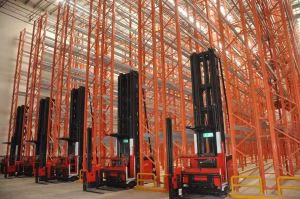
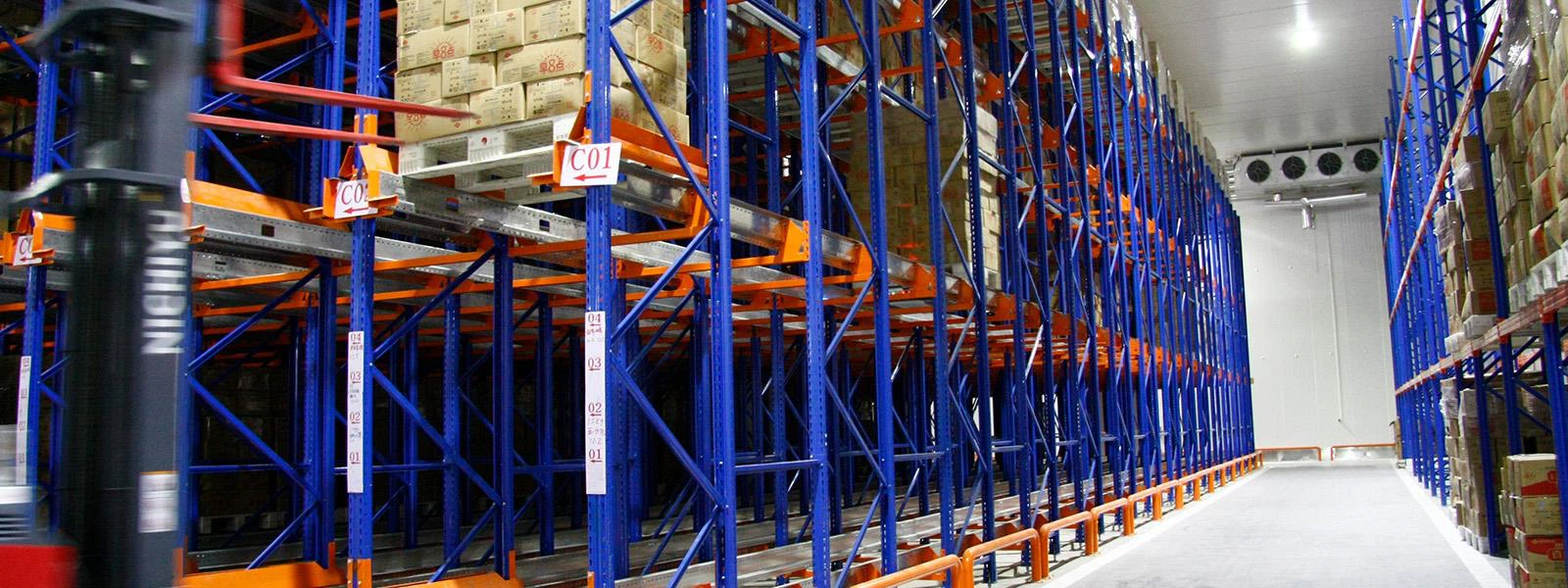
A true heavy-duty beam pallet rack system is an assembly of cold-formed structural components designed to absorb static payload pressure, dynamic forklift impact, and seismic ground forces. The integrity of the system rests on three engineered components:
- Cold-Rolled Upright Frames: Manufactured from premium Q235B or Q355B structural steel coils. Our upright profiles feature multi-stage continuous roll-forming with pitch adjustments at 50mm, 75mm, or 76.2mm (3 inches). Upright column widths range from 80mm to 120mm with steel wall thicknesses up to 2.5mm or 3.0mm to withstand high vertical column loads.
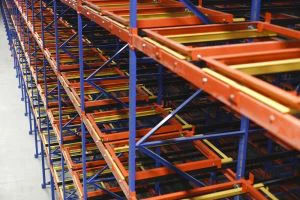
- Interlocking Box Beams & Step Beams: Beams are formed by stitching two special C-profile sections together via automated robotic continuous welding. This box-section geometry delivers high resistance to lateral torsion and vertical bending moments under concentrated pallet footprints.
- Multi-Claw Connector Locks with Safety Pins: High-tensile steel connector claws (3-hook or 4-hook configurations) are precision welded to beam ends. Every beam connection utilizes an automatic drop-in spring safety pin that prevents accidental beam dislodgement caused by upward forklift driver error.
Technical Highlight: Understanding Beam Deflection ($L/200$ Standard)
Engineers calculate maximum allowable beam deflection under full static load using the ratio $L/200$, where $L$ represents the clear span of the beam between upright columns. For a standard 2700mm beam carrying two 1200kg pallets (total 2400kg payload), maximum flex deflection must not exceed 13.5mm. Random Racks Storage Equipment Co., Ltd. designs every beam section with a structural safety margin exceeding 1.65 to ensure zero permanent deformation over decades of continuous warehouse utilization.
Contact Us 2. Product Selection Matrix: Recommended Heavy Duty Beam Rack Configurations
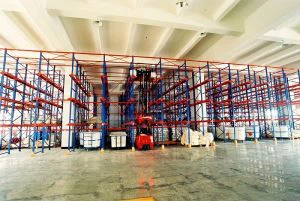
Depending on your stock-keeping unit (SKU) diversity, inventory turnover rate, and material handling equipment (MHE), Random Racks engineers customized heavy duty beam racking into distinct performance configurations:
3. Future Procurement & Development Trends in Heavy Duty Racking (2025–2030)
As global supply chains modernize, buying behaviors for industrial storage infrastructure are changing rapidly. Modern procurement strategies focus on four structural trends:
A. Seamless Integration with AGVs, AMRs & ASRS Systems
Standard heavy-duty beam racks are evolving into high-precision structural grids capable of interfacing with Autonomous Mobile Robots (AMRs) and Automated Storage and Retrieval Systems (ASRS). Structural tolerance requirements have tightened from $\pm 3\text{mm}$ to under $\pm 1\text{mm}$. Random Racks Storage Equipment Co., Ltd. utilizes automated robotic laser cutting and punching systems to guarantee the rigid tolerances required by automated optical sensors and robotic grippers.
B. Sustainability, Low-Carbon Steel & Eco-Powder Coatings
Multinational enterprises require green supply chain documentation. Random Racks utilizes recyclable steel stock and non-toxic, TGIC-free thermosetting epoxy-polyester powder coatings. Our automated coating lines run zero-VOC recovery systems while delivering superior salt-spray corrosion resistance (up to 500 hours) for harsh warehouse environments.
C. Dynamic Seismic Engineering & Finite Element Analysis (FEA)
Seismic risk mitigation is mandatory across North America, South America, Oceania, and Japan. Modern buyers demand custom finite element analysis (FEA) showing how heavy duty beam racks withstand horizontal shear forces. Random Racks custom-engineers baseplates, seismic anchor bolts, and heavy-duty frame bracings certified to withstand seismic zones up to Richter magnitude 8.0.
 100% Selective