Featured Industrial Storage & High-Density Racking Systems
Factory-Direct Heavy-Duty Racking and Automated Storage Solutions Exported to Supply Chain Operations Across Canada
1. Executive Summary & Whitepaper Scope: Radio Shuttle Racking in Canada
As the Canadian logistics real estate market faces sustained pressure—driven by escalating land costs in primary hubs like the Greater Toronto Area (GTA), Metro Vancouver, and the Calgary Logistics Corridor—industrial warehouse operators are compelled to maximize cubic storage density. Traditional drive-in racking and standard selective pallet racks frequently present operational bottlenecks, including high forklift damage rates, poor space utilization, or restricted inventory throughput.
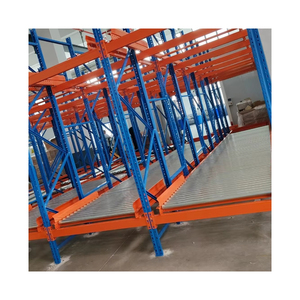
Radio Shuttle Cart systems (also referred to as pallet runners, shuttle racks, or semi-automated high-density storage systems) represent a transformative middle-ground between manual racking and multi-million-dollar fully automated storage and retrieval systems (AS/RS). By deploying self-powered, radio-controlled shuttle carts into specialized racking channels, Canadian enterprise operators can achieve up to 80% cube utilization while dramatically slashing forklift travel distance, labor overhead, and building footprint costs.
As a leading China-based radio shuttle cart manufacturer and structural steel racking exporter established in 2004, Random Racks Storage Equipment Co., Ltd. provides Canadian engineering managers, 3PL providers, and cold-chain operators with fully compliant, heavy-duty shuttle cart racking systems. This whitepaper details our structural metallurgical standards, low-temperature lithium battery performance, Canadian Building Code (NBCC) compliance, and targeted local logistics applications across Canadian provinces.
Key Information Gain Insight: Shuttle cart systems deployed in Canadian sub-zero food distribution centers yield an average of 42% energy saving per pallet position compared to standard selective racking by consolidating refrigerated airspace and reducing door open-times.
2. Technical Architecture of Radio Shuttle Cart & Rack Systems
The Radio Shuttle Cart system relies on a dual-component engineering model: high-precision roll-formed structural steel racking rails and an electromechanical self-guided shuttle vehicle. The shuttle cart moves independently along deep-channel rails beneath pallet positions, raising, carrying, and lowering pallets in response to handheld RF remote controls or integrated Warehouse Management Software (WMS) signals.
Low-Temp LiFePO4 Power
Industrial Lithium Iron Phosphate battery modules integrated with internal heating jackets designed specifically to maintain 8+ hours of uninterrupted operational cycle times in Canadian cold rooms down to -30°C.
Laser Guidance & Obstacle Sensing
Multi-point optical sensors, end-of-track laser decelerators, and anti-collision safety bumpers ensure precise pallet placement within +/- 2mm tolerances and instantaneous stop upon obstacle detection.
Dual FIFO / LIFO Operations
Configurable for Last-In-First-Out (LIFO) deep channel loading or First-In-First-Out (FIFO) continuous throughput where loading occurs at the rear aisle and retrieval takes place at the front face.
Technical Specification Matrix: Radio Shuttle Vehicles
Our shuttle carts are engineered using industrial-grade components sourced to meet international electrical and mechanical durability standards:
| Engineering Parameter | Standard Shuttle Cart Model | Cold Storage / Heavy Duty Model |
|---|---|---|
| Rated Load Capacity | 1,000 kg – 1,500 kg (2,200 lbs – 3,300 lbs) | 1,500 kg – 2,000 kg (3,300 lbs – 4,400 lbs) |
| Lifting & Travel Speed | Loaded: 0.8 m/s | Unloaded: 1.1 m/s | Loaded: 0.7 m/s | Unloaded: 1.0 m/s |
| Operating Temperature Range | -5°C to +45°C (23°F to 113°F) | -30°C to +40°C (-22°F to 104°F) |
| Battery System & Endurance | 24V/40Ah Lithium-Ion (6-8 hours) | 24V/60Ah Low-Temp Heated LiFePO4 (8-10 hours) |
| Control System | RF Remote / Touchscreen Tablet / WMS Integration | Industrial PLC with Wireless Mesh Network & WMS API |
| Structural Frame Material | Aircraft-grade Aluminum Alloy & Steel Chassis | Reinforced Stainless Steel & Cold-Resistant Alloy Chassis |
| Pallet Compatibility | GMA (48"x40"), EURO (1200x800), Custom Sizes | Canadian Standard GMA 48"x40", Heavy Duty Metal Pallets |
3. Structural Engineering & Canadian Regulatory Compliance (NBCC & CSA)
Exporting warehouse racking equipment to Canada requires strict alignment with local building safety codes, structural engineering standards, and electrical safety certifications. Random Racks designs and manufactures all racking components to withstand rigorous mechanical stresses and seismic requirements defined by Canadian governing bodies.
National Building Code of Canada (NBCC) & CSA S16 Design Compliance
Structural steel rack frames engineered for installation in provinces such as British Columbia, Ontario, or Quebec must adhere to the design specifications set forth by CSA S16 (Design of Steel Structures) and CSA A344 (User Code for Steel Storage Racks). Key engineering considerations provided by our technical team include:
- Seismic Loading Calculations: Western Canada (e.g., Greater Vancouver, Vancouver Island) represents a high seismic risk region (Zone 4 equivalent). Our structural engineering team performs dynamic seismic analysis, integrating extra-thick baseplates, anchor bolts engineered to resist uplift, and heavy-duty horizontal framing to conform to NBCC spectral acceleration maps.
- Structural Steel Grade: We utilize premium Q235B and Q355B structural steel coils with verified mill test reports (MTRs), matching or exceeding ASTM A1011 Grade 50 requirements for load-bearing columns and beam profiles.
- Electrical Safety (CSA / UL Equivalence): Battery chargers and shuttle internal power circuits destined for Canada are manufactured with components compliant with CSA C22.2 No. 107.1 safety standards for power conversion equipment, ensuring smooth electrical inspection clearance by local authorities.
4. Canadian Localization & Industry Application Scenarios
Canada’s vast geographic expanse and diverse regional economies require customized warehouse storage designs suited to specific local industrial demands:
Greater Toronto Area (GTA) & Peel Region
E-commerce fulfilment centers and 3PL hubs in Brampton, Mississauga, and Vaughan demand rapid SKU replenishment and high cube efficiency. Shuttle systems allow 10+ deep pallet storage lanes, minimizing valuable warehouse real estate consumption.
Calgary & Edmonton Agriculture / Logistics Hubs
Alberta serves as a central distribution gateway for agricultural produce, packaged food, and industrial equipment. Our shuttle racking offers heavy-load tolerance up to 2,000 kg per pallet position for grain, meat, and beverage distribution.
Quebec Cold Storage & Seafood Corridors
From Montreal to Quebec City, cold-chain operators rely on low-temperature shuttle carts to prevent thermal leakage. Condensed high-density channels dramatically lower refrigeration energy demand per pallet stored.
5. Local Logistics & Warehousing Trends in Canada (2025–2030)
Synthesizing operational data across Canadian warehousing sectors reveals several macro trends accelerating the shift toward semi-automated pallet runner technology:
- Industrial Land Scarcity & Rental Hikes: Net effective rents for industrial real estate in major Canadian urban markets remain significantly higher than pre-2020 levels. Expanding vertically with radio shuttle racking allows companies to avoid costly facility relocations or warehouse additions.
- Labor Market Constraints & Wage Increases: Warehouse labor availability across Canada continues to tighten. Shuttle cart systems optimize forklift operator efficiency by up to 50%, enabling fewer drivers to manage higher throughput volumes safely.
- Decarbonization & ESG Commitments: Canadian corporate sustainability mandates focus heavily on reducing warehouse energy consumption. High-density shuttle systems reduce illuminated and climate-controlled volume requirements, supporting Net-Zero operational pathways.
6. Direct Comparison: Shuttle Racking vs. Traditional High-Density Racking
| Storage Criteria | Radio Shuttle Cart Racking | Drive-In Racking | Push-Back Cart Racking | Fully Automated AS/RS |
|---|---|---|---|---|
| Storage Density | Very High (Up to 85%) | High (Up to 65%) | Moderate (Up to 60%) | Maximum (Up to 90%) |
| Pallet Selectivity | Medium (Lane-by-Lane) | Low (Block Storage) | Medium (2–6 Deep) | High (System Controlled) |
| Forklift Damage Risk | Near Zero (Trucks stay in aisle) | High (Trucks enter rack) | Low (Trucks stay in aisle) | Zero (Automated Cranes) |
| Lane Depth Potential | 40+ Pallets Deep | Max 8-10 Pallets Deep | Max 5-6 Pallets Deep | 50+ Pallets Deep |
| Capital Investment (CAD) | Moderate / Fast ROI (12-18 mo) | Low Initial Cost | Moderate Initial Cost | Very High (Capital Intensive) |
7. Enterprise Manufacturing Advantages of Random Racks Storage Equipment Co., Ltd.
Founded in 2004 with brand registration in 2012, Random Racks Storage Equipment Co., Ltd. operates state-of-the-art production facilities in Nanjing, China. With two decades of dedicated research, structural design, and international export experience, we deliver end-to-end reliability for Canadian warehouse procurement managers.
- In-House Manufacturing Control: We operate precision continuous roll-forming lines, automated robotic welding stations, and an eco-friendly automated powder-coating system. Every rack beam, upright, and shuttle guide rail is crafted from certified steel coils under ISO 9001 quality management.
- Free 3D/CAD Layout Engineering: Send us your warehouse floor plan, clear height specifications, forklift turning radius, and pallet parameters. Our structural engineering department delivers complete CAD drawings, 3D structural renders, and exact bill of materials (BOM) prior to contract signing.
- Rigorous Third-Party Testing: All structural beam connectors, upright frames, and shuttle rails undergo load deformation and fatigue testing. Full test reports certified by international bodies (such as SGS or CE) are supplied upon request.
- Seamless Export Packaging & Canadian Ocean Shipping: Racking components are bundled with steel strapping, corner protectors, and moisture-proof plastic wrap to withstand ocean transit to major ports including Vancouver, Montreal, and Halifax. We assist Canadian buyers with customs documentation, FOB/CIF terms, and optional DDP door-to-door delivery.
8. Frequently Asked Questions by Canadian Buyers
What engineering information is required to design a radio shuttle cart system for my Canadian facility?
How do your shuttle cart batteries perform in Canadian cold storage conditions (-20°C to -30°C)?
Does your pallet racking comply with Canadian standard GMA 48" x 40" wood and plastic pallets?
What design standards do your structural racking components follow?
What is the typical production and shipping lead time to Canada?
Do you provide installation support for projects located across Canadian provinces?
Can the Radio Shuttle system integrate with our existing Warehouse Management System (WMS)?
What warranty and spare parts support is included with your shuttle carts?
Optimize Your Canadian Warehouse Capacity Today
Contact our senior engineering team for a complimentary 3D CAD layout, load capacity consultation, and competitive direct factory quote tailored to your operational requirements.
Get a Quote