High-Density Radio Shuttle Systems & Equipment
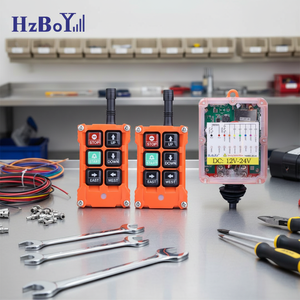
Explore our CE-certified, factory-direct automated shuttle carts, heavy-duty racking channels, and specialized remote transmitters engineered for high-throughput distribution hubs.
Optimizing Costa Rican Warehousing: Land Cost, Seismic Risk & Export Growth
Supply chain infrastructure across Central America is under intense transformation. In Costa Rica's industrial hubs, modernizing intralogistics is no longer optional—it is a competitive mandate.
Gran Área Metropolitana (GAM) Real Estate Pressures
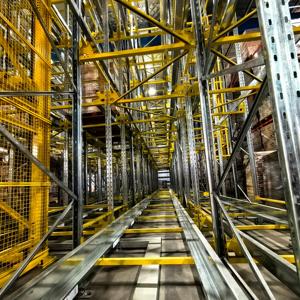
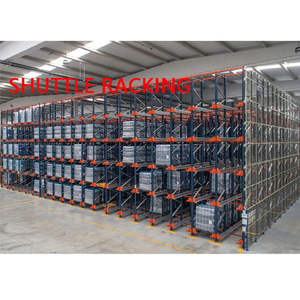
Industrial land prices in prime zones such as Coyol de Alajuela, Heredia, and Cartago have reached historical highs, exceeding $180–$250 per square meter. Warehouse operators can no longer afford wide forklift aisles. Radio Shuttle Racking eliminates up to 80% of inner aisles, allowing logistics managers to maximize vertical clearance up to 16+ meters without expanding structural footprints.
Strict Seismic Engineering (Código Sísmico CSCR-2010)
Located on the Pacific Ring of Fire, Costa Rica presents high peak ground acceleration (PGA) risks. Standard racking layouts often fail under lateral seismic stress. Our Radio Shuttle Racking systems utilize high-tensile Q355B cold-rolled steel, heavy-duty baseplates, and custom X-bracing frameworks engineered specifically to satisfy CSCR-2010 seismic vibration forces and prevent structural rack collapse.
High-Density Cold Chain for Agricultural Exports
As the world's leading exporter of fresh pineapples and a top exporter of medical devices, Costa Rica demands strict cold-chain compliance (SENASA / FDA standard). Maintaining freezer rooms at -25°C to -30°C incurs extreme electricity costs. Our automated shuttle carts shrink room volume per pallet, reducing energy dissipation by up to 35% in cold distribution centers near Puerto Caldera and Moín Container Terminal.
Engineering Architecture: 2-Way vs. 4-Way Radio Shuttle Mechanics
Understanding the mechanical, electronic, and structural distinctions between semi-automated 2-Way shuttles and fully automated 4-Way multi-directional shuttles is vital for capital expenditure ROI.
2-Way Radio Shuttle System (Semi-Automated)
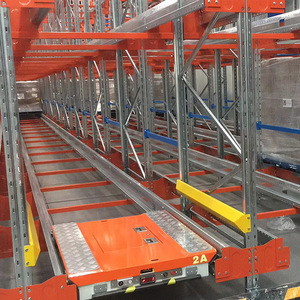
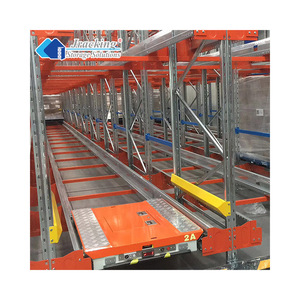
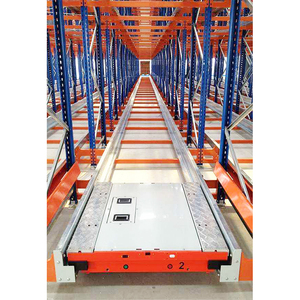
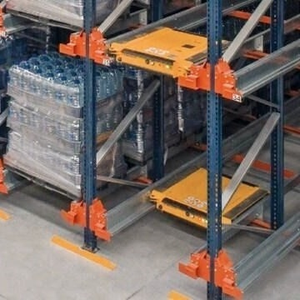
The 2-Way Radio Shuttle cart operates along deep rails within a designated channel, executing back-and-forth movement for pallet placement and retrieval. A standard forklift lifts the cart between channels.
- Operation Mode: Semi-automated (Forklift handles lane transitions; shuttle handles channel depth).
- Ideal Throughput: Moderate to high volume for medium-depth SKUs (6 to 20 pallets deep).
- Inventory Rotation: Easily switchable between LIFO (Last-In, First-Out) and FIFO (First-In, First-Out).
- Payload Capacity: Up to 1,500 kg per pallet at speeds up to 1.1 m/s (unloaded) and 0.8 m/s (loaded).
- Battery System: Quick-swap Lithium Iron Phosphate ($LiFePO_4$) battery providing 8 to 10 hours of continuous operational duty cycle.
4-Way Radio Shuttle System (Fully Automated AS/RS Integration)
The 4-Way Radio Shuttle cart can traverse both longitudinal storage channels and transverse transfer aisles. Combined with automated vertical lifts, it forms a full AS/RS solution without requiring forklifts inside storage bays.
- Operation Mode: Fully automated intelligent fleet controlled via WMS/WCS software over industrial Wi-Fi.
- Ideal Throughput: High-speed 24/7 continuous operations with dynamic cross-lane routing.
- Space Utilization: Reaches up to 95% volumetric efficiency, eliminating driver forklift aisles completely.
- Payload Capacity: Heavy-duty chassis engineered for 1,200 kg to 2,000 kg pallet loads with laser alignment sensors.
- Smart Features: Auto-charging stations, obstruction detection sensors, and real-time operational diagnostics.
Comparative Performance: Shuttle Racking vs. Traditional Systems
Evaluating financial payback, operational efficiency, and spatial utilization metrics across competing warehouse storage topologies.
| Storage Topology | Volumetric Space Utilization | Forklift Damage Risk | Inventory Rotation | Operating Cost (Labor) | Costa Rica Market Payback |
|---|---|---|---|---|---|
| Radio Shuttle Racking | Very High (85%–92%) | Minimal (No Entry into Lanes) | Flexible (FIFO / LIFO) | Low (Automated Handling) | 18 – 24 Months |
| Drive-In Racking | High (65%–75%) | High (Forklifts Drive Inside) | Strict LIFO Only | High (Slow Driving Speeds) | 24 – 36 Months |
| Selective Pallet Racking | Low (35%–45%) | Moderate (Wide Aisles) | 100% Selective (FIFO/LIFO) | High (Multiple Drivers Needed) | Baseline |
| Push Back Racking | Moderate High (60%–70%) | Low to Moderate | LIFO Only (Max 5 Deep) | Moderate | 30 – 40 Months |
Global Manufacturing Scale with Direct Costa Rican Export Support
Since 2004, Random Racks Storage Equipment Co., Ltd. has delivered structural excellence, rigorous quality testing, and turnkey intralogistics designs to overseas buyers.
20+ Years Quality Legacy
Founded in 2004 in Nanjing, China, operating full continuous automatic cold roll-forming lines, robotic welding stations, and automated powder coating facilities.
International Code Compliance
Engineered reference to FEM 10.2.02, EN 15512, RMI, and AS4084 design standards. Every shipment includes certified mill test reports and load verification.
Free 3D / CAD BIM Engineering
Submit your warehouse floor plan, clear height, and forklift specifications. Our engineering team returns custom 3D layouts and finite element calculation reports at zero cost.
Direct Maritime Shipping to Costa Rica
Decades of experience exporting to Central America via Shanghai/Ningbo ports directly to Puerto Limón (Atlantic) and Puerto Caldera (Pacific) with optimized container packing.
Frequently Asked Questions: Purchasing & Installation in Costa Rica
Clear, direct answers for warehouse managers, supply chain directors, and logistics engineers in Costa Rica.
How does your Radio Shuttle System adapt to Costa Rica's CSCR-2010 seismic requirements?
Costa Rica is classified as a high seismic hazard area under the Código Sísmico de Costa Rica (CSCR-2010). Our structural engineers calculate the exact peak ground acceleration (PGA) for your specific municipality (e.g., Alajuela, Cartago, or San José). We customize upright column profiles using high-tensile Q355B steel, increase baseplate dimensions, utilize chemical anchor bolts with deep embedment depth, and integrate heavy-duty longitudinal and vertical tower bracing to ensure structural stability during seismic events.
What is the typical shipping timeline from your factory to Puerto Caldera or Puerto Limón?
Once final 3D CAD drawings are approved, manufacturing takes approximately 20 to 25 days at our Nanjing facility. Ocean transit from major Chinese ports (Shanghai/Ningbo) to Puerto Limón (Atlantic coast for easy access to San José/Heredia) or Puerto Caldera (Pacific coast) takes approximately 28 to 35 days depending on the shipping line. Total lead time from order confirmation to arrival at your warehouse site is usually within 55 to 65 days.
Can the shuttle cart operate in extreme cold storage environments for food and fruit exports?
Yes. We manufacture specialized Cold Storage Radio Shuttle Carts rated for temperatures down to -30°C (-22°F). These models feature IP65-rated moisture-sealed electrical enclosures, low-temperature synthetic lubricants, anti-condensation internal heating elements for PLC circuitry, and cold-resistant Lithium Iron Phosphate ($LiFePO_4$) battery packs designed to maintain voltage stability in freezing environments such as pineapple pulp or seafood cold storage hubs.
How are installation and ongoing maintenance handled in Costa Rica?
Every project is shipped with comprehensive component labeling, step-by-step 3D assembly manuals, and video installation guides. For large-scale or automated projects, Random Racks can dispatch experienced installation supervisors to your site in Costa Rica to direct your local installation crew. Furthermore, our smart shuttle carts feature modular plug-and-play electronic components and remote diagnostic software over Wi-Fi for rapid troubleshooting.
What pallet types and dimensions are compatible with the Radio Shuttle rails?
Our shuttle rails and cart elevation mechanisms are highly versatile. We custom-engineer shuttle channels for standard 1200x1000 mm GMA pallets, 1200x800 mm Euro pallets, plastic agricultural containers, and heavy industrial steel pallets. We recommend a minimum pallet quality threshold to prevent deflection, and our shuttles come equipped with optical sensors to detect damaged timber pallets automatically before hoisting.
Ready to Double Your Warehouse Capacity in Costa Rica?
Send your building dimensions, pallet specs, and storage goals to our senior intralogistics engineers today. Receive a free 3D CAD layout, structural load calculation, and factory-direct quotation within 24 hours.